


Product
Featured



MAX Impact:
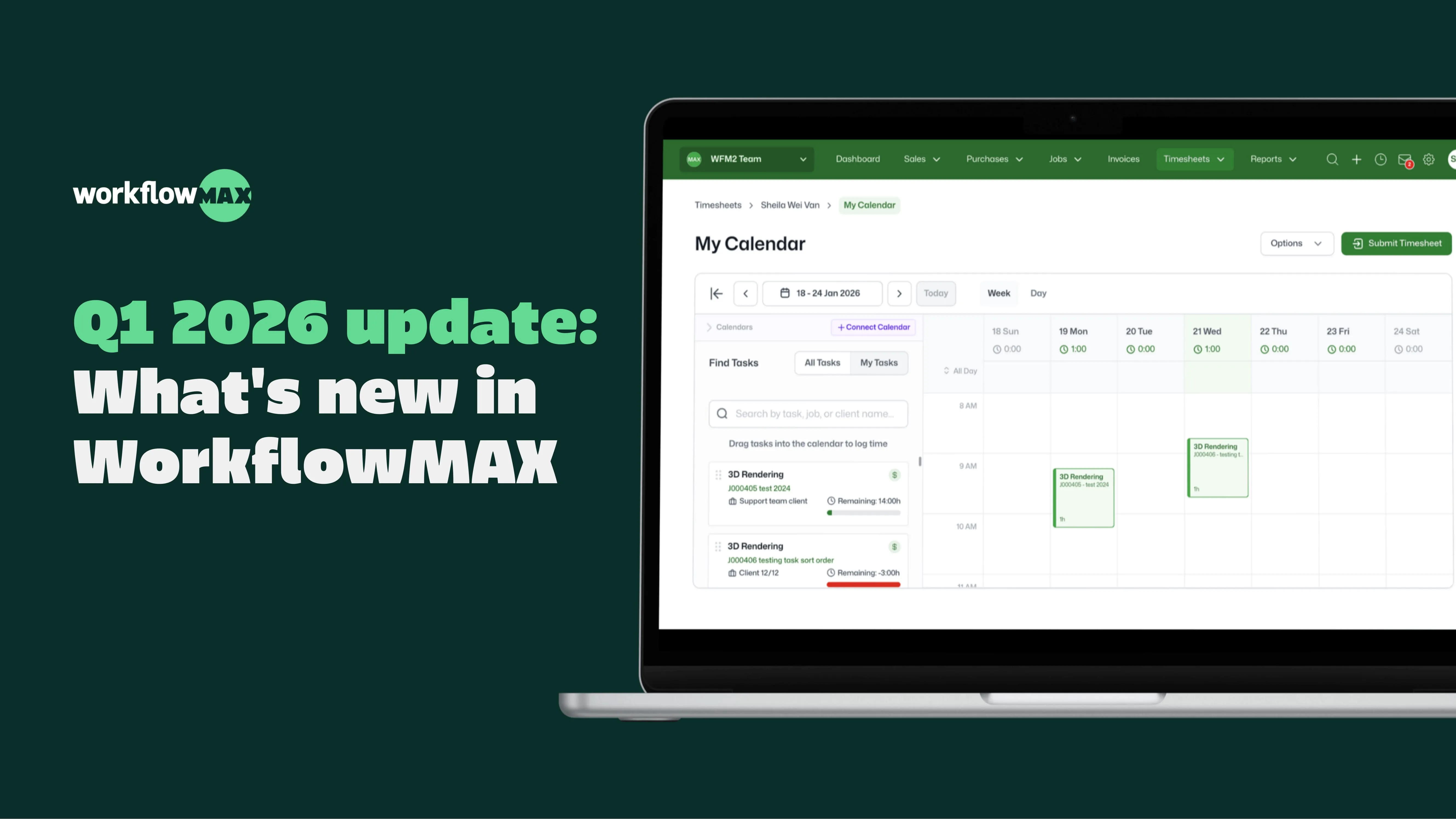
Watch the Q1 2026 product update video for a quick tour of the latest WorkflowMAX features.
The problem: Your team spends half the day in meetings, then manually recreates that schedule in timesheets at the end of the week. It's redundant, time-consuming, and leads to forgotten billable hours.
What's new: Our Integrated Calendar feature now syncs directly with Microsoft Outlook and Google Calendar. Your meetings, appointments, and events appear in WorkflowMAX automatically, ready to convert to timesheet entries with a few clicks.
Why it matters: No more double data entry. If it's on your calendar, it can be billable. One beta customer reported saving 2-3 hours per week on timesheet entry.
Currently in beta for Advanced plan customers
Learn more ->
The problem: It's Monday morning, and half your team still hasn't submitted last week's timesheets. You're sending reminder emails, chasing people individually and delaying invoicing.
What's new: Timesheet Approvals & Reminders lets you set up automated reminder workflows and approval chains. The system does the chasing for you, escalating reminders until timesheets are submitted and approved.
Why it matters: Timesheets get submitted on time. Approvals happen faster. You invoice sooner. That's one weekly task off your plate.
Reminders available in beta for Premium & Advanced plans; Approvals available for Advanced plans
The problem: Your business runs on multiple tools, and you're manually copying data between them.
What's new: WorkflowMAX is now on Zapier, which means you can connect it to over 8,000 other apps without writing code. Automatically create jobs from CRM deals, sync contacts, trigger Slack notifications, or push data to your BI tool.
Why it matters: Automation eliminates manual data transfer and keeps your systems in sync. Build the workflows your business actually needs.
Available for Premium & Advanced plans
The problem: You're working with suppliers overseas, juggling multiple currencies, and trying to keep exchange rates straight while issuing quotes and invoices.
What's new: Multi-currency support for purchase orders and bills. Create POs and bills in any currency, and WorkflowMAX handles the conversions automatically.
Why it matters: If you work with international suppliers, this removes a major pain point. Create a PO in their currency, bill in their currency, and let the system do the math.
Currently in beta for Premium & Advanced plans
The problem: You need the same reports every week - WIP, project profitability, resource utilisation - but you're manually generating and distributing them each time.
What's new: Scheduled Reports lets you set up any custom report to run and deliver automatically. Daily, weekly, monthly, or yearly - configure it once and the system handles the rest.
Why it matters: Consistent reporting without the manual work. Your leadership team gets the data they need, when they need it, without you having to remember to send it.
Available for Advanced plan customers
Each of these features tackles a specific pain point, but together they represent something bigger: less time on admin, more time on the work that matters.
Project-based businesses run on accurate data - time, expenses, costs, and schedules. But gathering that data shouldn't consume your day. These updates are designed to automate the busywork, reduce errors, and give you real-time visibility into how your projects are actually performing.
Here's a taste of what else we're working on this quarter:
We can’t wait to see how you use these features in practice. Please continue to share your feedback, use cases, or challenges - your input is key to helping us refine WorkflowMAX together.
.jpg)
TL;DR: Managing invoices manually exposes service businesses to errors, delays, and potential fraud. AI‑powered invoice validation and fraud detection offer a smarter, more secure approach to e‑invoicing, reducing risk and streamlining financial workflows. With WorkflowMAX, professionals gain control over project finances through seamless integration, real-time insights, and automation that keeps billing accurate and compliant.
Across architecture, creative, engineering, and accounting firms, accurate and timely payment is fundamental to staying in business.Yet, invoicing remains one of the most error-prone, manually intensive processes in many businesses.
Late payments. Double billing. Fraudulent invoices. Small errors snowball into serious financial headaches, affecting cash flow and profitability. As e‑invoicing becomes standard across Australia, New Zealand, and the UK, so too does the expectation for speed, accuracy, and compliance.
Enter AI‑powered invoice validation and fraud detection, an emerging necessity in the modern job management stack. It’s not just about automation anymore; it’s about making sure every invoice is correct, legitimate, and paid fast.
Even the most detail-oriented professionals can’t catch every discrepancy manually. In fact:
Traditional invoicing processes are reactive. You send an invoice, wait for a response, and fix issues after they’ve already become bottlenecks. Worse, multiple tools, spreadsheets, email, accounting software often don’t "talk" to each other, creating data silos and risks.
AI‑powered invoice validation tools are reshaping how modern firms handle invoicing. Rather than relying on human input alone, AI systems:
The result? Fewer disputes. Faster payments. And confidence that your numbers reflect reality.
To enable accurate invoice validation, data from job tracking, quoting, and time logs needs to live in one place. This allows AI systems to "see the full picture" and compare line items with actual work delivered.WorkflowMAX integrates quoting, time tracking, job costing, and invoicing ensuring that the data AI tools needed for validation are accurate, connected and up-to-date.
Instead of reviewing invoices at the end of the month, modern systems allow validation as you build the invoice. This means any anomalies are flagged before the invoice is sent saving time and reputation.
Because WorkflowMAX tracks project costs and time in real-time, it can pre-validate invoice totals against what was actually worked creating a "right the first time" approach to billing.
AI tools can automatically flag:
These alerts help internal teams prevent fraud before funds leave the account.While not a dedicated fraud detection platform, WorkflowMAX’s integration with Xero and other accounting tools creates a unified source of truth. When combined with audit trails and role-based access controls, it provides the foundation for secure billing.
Regulatory bodies are increasingly mandating e‑invoicing standards for tax compliance, particularly for government suppliers. AI‑driven systems help ensure compliance with formats, rules, and reporting requirements.WorkflowMAX integrates with e‑invoicing-friendly platforms (like Xero and QuickBooks), enabling smooth compliance workflows and reducing the burden on finance teams.
Technology alone doesn’t solve invoicing challenges. Make sure your team understands the AI prompts, flags, and alerts they’re seeing. Clients also benefit from clearer, faster invoices that match expectations.
Built for service businesses that live on tight margins, WorkflowMAX connects invoicing, costs, and profitability in one system.
Here’s how it supports AI‑powered invoice validation:
This unified workflow eliminates guesswork, speeds up billing, and reduces the risk of disputes or fraud. As one partner shared during onboarding, “It’s not just about getting invoices out it’s about trusting the numbers inside them”.
For architecture firms quoting multi-phase builds, or agencies juggling dozens of client retainers, invoicing isn’t just admin, it’s your cash flow. With AI‑powered validation and fraud detection, you can send invoices with confidence, protect your business, and free up your team to focus on what they do best.
WorkflowMAX delivers the clarity, control, and efficiency needed to make smarter billing a reality.Ready to invoice smarter and faster? Try workflowMAX’s full quoting‑to‑invoicing workflow today, designed to reduce risk, improve accuracy and protect your profit.

TL;DR: Handling multi-currency transactions and cross-border taxes in e-invoices is a growing challenge for service-based businesses. Firms operating internationally, especially architects, engineers, designers, and consultants, need tools that manage complex tax rules and currency conversions without slowing down operations. This article explains how to handle multi-currency and tax compliance efficiently, and how WorkflowMAX supports this process with streamlined invoicing and reporting tools.
As firms grow and expand across borders whether it’s an Australian design agency billing a client in London, or a UK-based engineering firm subcontracting teams in New Zealand the complexity of financial operations grows as well. Different tax regimes. Fluctuating exchange rates. Local compliance obligations. It’s a lot to manage.
For service-based professionals, managing these complexities in their invoicing systems isn’t just about being compliant, it's about staying efficient and profitable. But without the right systems in place, firms risk manual errors, delayed payments, and even penalties.
This is where multi-currency e-invoicing and automated tax handling become game changers.
Many growing firms operate in one home currency (e.g. GBP, AUD, or NZD) but serve clients across globally. Without real-time currency updates, teams may quote one rate and invoice another, eroding margins and creating disputes.
Exchange rate errors or delays in currency conversion result in lost revenue or friction with clients.
Every jurisdiction handles tax differently. For example, VAT in the UK, GST in Australia and New Zealand, and state-based sales tax in parts of the US. For architecture or engineering firms working globally, this introduces inconsistent tax rules across different projects.
Tax misclassification or wrong rates can trigger compliance risks and delays in payments.
Many firms still juggle quotes in spreadsheets, time in one app, and invoicing in another. This fragmented stack means key tax settings or currency details don’t carry over seamlessly.
Duplication of data, human error, and wasted hours reconciling systems.
One of the most effective ways to reduce errors is to consolidate quoting, time tracking, and invoicing into one platform. This ensures that the correct currency and tax settings are applied from the first quote to the final invoice.
Tip: Use a system where you can set the billing currency at the job level and apply consistent tax rates per region.
Each client should be billed with the correct tax treatment based on their location and your own. The right e-invoicing tool will automatically apply GST/VAT exemptions where applicable (e.g. exports), or ensure tax is correctly calculated for each invoice line item.
Tip: Choose an invoicing system that allows region-based tax rules and handles both inclusive and exclusive tax models.
Using real-time currency conversion avoids revenue loss when invoicing in a foreign currency. This also prevents client disputes caused by inconsistent amounts due to outdated exchange rates.
Use platforms that sync daily exchange rates and allow historic rate locking for consistent quoting.
Invoices aren’t one-size-fits-all. They need to comply with the formatting and tax rules of the client’s location.That includes correct tax IDs, line-level tax breakdowns, and compliance with e-invoicing standards like Peppol (used across AU, NZ, EU).
Your system should output country-specific invoice formats and capture the right client tax information from the outset.
Cross-border invoicing creates real operational challenges for mid-sized service businesses. WorkflowMAX supports these needs with built-in capabilities.
For architects, engineers, creative agencies, and consultants, global business opens new doors and new challenges.Getting paid across borders, in different currencies, and under different tax regimes doesn’t have to be hard but it does require smart systems.
WorkflowMAX helps centralise and automate multi-currency e-invoicing and tax handling, so your teams can focus on the work, not the admin.
Multi-currency and cross-border tax handling is no longer a “nice-to-have” but a business necessity for professional service firms working globally. With increasing compliance requirements and client expectations, firms need clarity, control, and confidence in every invoice they send.
WorkflowMAX is designed to make that possible. With its flexible invoicing, tax automation, and seamless integrations, it acts as the financial engine behind your international growth.
Ready to simplify multi-currency invoicing and tax compliance? Explore how WorkflowMAX can help your firm bill globally with clarity and confidence.
.jpg)
TL;DR: Service firms lose significant time and profit not because they’re under-resourced, but because their workflows aren’t doing enough of the heavy lifting. Smart workflow design can dramatically improve productivity, reduce admin noise, and give teams clearer control over projects and compliance. By combining structured processes with the right automation, tools like WorkflowMAX help architects, engineers, accountants, and designers gain visibility, bill accurately, and operate with confidence, not chaos.
In a professional services firm, productivity is the difference between a project that's profitable and one that just "breaks even." Whether you’re an architect juggling regulatory hurdles or an engineer coordinating a massive technical team, the struggle is the same: the work gets done, but the process feels like wading through mud.
A well-designed workflow t streamlines tasks. and reduces rework, improves compliance, and creates clarity across the entire organisation. When supported by automation and the right tools, workflows become systems that free people from repetitive admin so they can focus on higher-value work.
This article explores how smarter workflow design leads to genuine productivity gains and how WorkflowMAX supports firms in making those gains real.
A “workflow” is more than a set of tasks. It’s the engine behind how your business operates day-to-day. When it’s clogged or confusing, you see the symptoms quickly:
These issues aren’t signs of poor performance,they’re usually workflow issues. Many firms operate with processes that were designed years ago for fewer clients, smaller teams, or less compliance obligations.
A well-designed workflow doesn’t just move tasks along; it kills off rework, automates the "boring bits," and gives your team the mental space to do the high-value work they actually enjoy.
What are the common workflow gaps limiting productivity across service-based organisations?
How many hours a week does your team spend chasing timesheets, exporting data for invoices, or preparing status reports? That’s "Manual Admin Tax.”.
Automation isn’t about removing human judgement. It’s about removing repetitive friction. When your firm automates routine steps, like generating invoices based on actual time, or triggering reminders for key dates, your team gets real hours back.
How WorkflowMAX helps: Automation across job templates, invoicing, time reminders, and reporting reduces back-and-forth admin so teams can focus on the work clients actually pay for.
Many firms operate with fragmented views of performance. Your architects may see tasks, your finance manager sees invoices, your project lead sees resourcing, but nobody has the full picture.
This makes it hard to act with confidence:
If you don’t know where your hours are disappearing, you don’t know your profit margins. Productivity doesn't just vanish; it leaks out through duplicated effort and hesitant decisions. We help you bridge that gap, giving you a clear, honest look at the relationship between your time and your bottom line
How WorkflowMAX helps: Job costing, real-time reporting, and integrated time tracking give every role.
A high-performing workflow relies on a cohesive system rather than an ever-growing pile of software.Yet many tools require workarounds, patch-ons, or complex templates that slow teams down.
When processes don’t align with how people naturally work, productivity suffers. Tasks get bypassed. Approvals go missing. Tracking becomes optional. And compliance headaches grow.
How WorkflowMAX helps: Customisable job templates, flexible task structures, and configurable workflows that match the real operational rhythm of A/E/C and professional service firms.
Many firms still move data between tools manually: copying time entries to invoicing systems, exporting financials to spreadsheets for analysis, shifting documents between shared drives and project folders.
Disconnected systems create:
How WorkflowMAX helps: Native integrations with accounting platforms like Xero and QuickBooks reduce double-entry and keep financial workflows accurate and current.
Improving your workflow isn't about buying more tools; it's about building a better system.
Before you automate anything, you need to understand every step of the workflow from enquiry to invoice.
A simple mapping exercise reveals:
With the right view, you can redesign workflows for speed, accuracy, and accountability.
We support clarity at every stage, that’s why we say: “Clarity creates confidence.”
Not everything should be automated, but a surprising amount can be. The goal is to free teams from low-value work without compromising quality or compliance.
Examples of effective automation:
WorkflowMAX features that support this:
If it’s clunky, people won't do it. If it's integrated and mobile-friendly, it just happens.When time entries are simple, mobile-friendly, and connected directly to job phases, accuracy improves without effort.
Better time tracking leads to:
Our platform makes this easy: Its integrated time tracking connects directly to job tasks, making it effortless to record time and understand its impact on profit.
In architecture, engineering, and accounting, compliance isn’t optional but it doesn’t have to be a headache. Most firms treat compliance as a "side-quest" that people forget until a deadline hits.
Smarter workflows embed those steps into the work itself. With WorkflowMAX, you can:
Good workflow design empowers roles across the business, not just managers.
For example:
Project leaders need a clear line of sight to make good calls. When they can see exactly where a project stands, they can hand out tasks with precision and keep the team moving. Visibility is the difference between a team that’s constantly second-guessing and one that’s operating in total lockstep.
Automation works best when it’s built on a workflow that already makes sense. Once your process is set, automation turns it into a high-performance engine:
Admin tasks like creating invoices, chasing timesheets, and preparing progress reports can be automated or triggered automatically.
This reduces:
Automated data capture gives you a financial snapshot of every project,before issues turn into losses.
With workflowMAX:
Automated workflows standardise best practice:
This reduces operational risk and maintains quality across the organisation.
When workflows are clear and automated:
In other words, automation reduces mental clutter. And mental clarity leads to productivity gains.
Ready to shift? Here is the roadmap to getting it done with WorkflowMAX:
Document the workflow end-to-end. Identify friction points. Capture where delays, confusion, or duplication occur.
Involve the people who do the work. Determine:
Let these templates handle:
Integrate WorkflowMAX with:
This removes double-handling and ensures everyone works from one truth.
Start simple. Then increase automation and visibility as the team gets comfortable with the system.
Firms don’t become more productive because they push teams harder. They become more productive when the workflow lifts the load: removing friction, reducing rework, and producing clearer insights.
Smarter workflow design paired with thoughtful automation transforms how teams coordinate, deliver, and make decisions. And with its human-centred approach, financial clarity, and powerful job management features, WorkflowMAX provides the foundation for service firms to operate with confidence,not chaos.
Ready to design workflows that actually work for your business?
Try WorkflowMAX for free and create clarity, control, and confidence across every project.
.jpg)
TL;DR: Many service firms unknowingly lose profit, time, and client confidence because their CRM and project management tools don’t talk to each other. Disconnected systems create double-handling, inaccurate forecasting, and unnecessary chaos,especially for architecture, engineering, consulting, accounting, and creative teams that manage complex workflows. This article breaks down the hidden costs of these fragmented systems and outlines the operational improvements firms can gain from unifying sales, jobs, time, and billing.
WorkflowMAX helps service firms regain control and clarity by connecting CRM, job management, time tracking, and financial data in one place, giving teams the visibility and confidence they need to run a high-performing practice.
Every service business runs on a single engine: the flow of work from the first "hello" (the lead) to the final "thank you" (the invoice).
When your CRM lives in one world, your project management in another, and your financials in a lonely spreadsheet, that engine misfires. Architects lose track of client changes. Engineers re-enter the same data three times. Creative studios run beautiful boards that have no idea what was actually sold in the contract.
This isn't a dramatic business failure; it's a constant, invisible leak. And for firms with tight margins, that leak is expensive.
This is why WorkflowMAX positions clarity, confidence, and calm as core to the brand. When tools work together, businesses can work smarter.
Many teams assume using separate tools for sales, projects, time tracking, and billing is normal. But fragmentation creates a ripple effect of operational issues that compound over time.
Switching between systems is just frustrating and it creates unnecessary admin:
For technical teams already stretched thin, admin absorbs time that should be spent delivering work.
This contradicts one of WorkflowMAX’s core principles: your tools should work for you, not the other way around.
An engineering consultancy wins a new client in their CRM. The project lead then has to manually create the job in a separate PM tool, update phase budgets in a spreadsheet, and draft a fee proposal again based on details already captured.
That’s 30–60 minutes of duplicated effort per project multiplied by every job, every month.
When CRM and delivery tools don’t share data, the handover from sales to project teams becomes risky:
The result? Margin leakage before the job even starts.
We believe in 'owning the result,' but you can’t take ownership of what you can't see. Disconnected tools give you a fractured story, bits of data scattered across different apps. We pull it all together, giving you the full narrative of a project from the initial pitch right through to the money hitting the bank.
Professionals don’t skip time tracking because they don’t care, they skip it because the process is clunky.
When tasks aren’t synced across systems, staff often:
Inaccurate time tracking wipes out the ability to understand profitability, improve workflows, or provide transparent reporting.
WorkflowMAX’s mission emphasises that clarity creates confidence. That clarity is impossible when data is fragmented across tools.
Disconnected systems result in:
This undermines leadership’s ability to make strategic decisions based on real numbers.
Being able to understand “where time is going, what it’s costing, and what it’s earning” is a core brand commitment, and disconnection blocks it.
When tools don’t talk, teams don’t either. Architects work in one app, accountants in another, and creatives on a visual board. This lack of shared visibility leads to the dreaded "Wait, I thought you were doing that" conversation.
And a lack of shared visibility leads to:
WorkflowMAX intentionally uses human-first, grounded communication to unite teams not divide them with tools that don’t talk.
Most firms only notice the symptoms (stress, late nights), but the true costs are deeper:
Every untracked hour is lost profit. Every duplicated hour is wasted cost.
For high-value professional services, losing even 2–5% of billable time materially impacts annual revenue.
If actual labour costs, scope changes, and expenses aren’t captured accurately, projects quietly leak money.
Lack of shared visibility means issues are caught late, sometimes too late to correct.
Professionals want to use tools that support efficiency, not restrict it. Fragmented workflows create unnecessary pressure on already busy teams.
Clients feel the effects of disconnection through:
Service firms grow through reputation. Disconnected systems put that reputation at risk.
Leadership needs accurate, real-time information about:
Fragmented systems cannot provide this.
Control, visibility, and confidence are the first things to go when your systems are scattered. If your tools don't talk, you’re the one stuck doing the manual heavy lifting to connect the dots.
The world for architects, engineers, and consultants has changed:
In the past, you could get away with disconnected tools because everyone was in the same room. Today, if your data is siloed, your team is flying blind. Many tools on the market are either too shallow for complex projects or so "enterprise-heavy" that they feel like a second job just to manage. WorkflowMAX sits in that sweet spot: deep enough for the details, but simple enough to actually use.
Integrating your CRM and project management it’s a business strategy. When your systems talk to each other, the "quiet drag" disappears and is replaced by a single, seamless flow.
Your client lifecycle looks a little like this when you use our platform:
Because CRM, quoting, and capacity data are connected, teams can reliably see:
This supports our core promise: empowering managers with accurate, actionable data.
Tasks flow automatically into timesheets. Whether your team is on a mobile at a site visit or at their desk, logging time becomes a natural part of the day, not a Friday afternoon guessing game.
Our reporting, dashboards, job costing, and WIP features provide clarity on:
This is how professional service firms shift from reactive to strategic, and why “clarity creates confidence” is a brand pillar.
Most systems feel like a second job, but this is designed to feel like a relief. By keeping things grounded and human, we’ve cut out the 'overwhelming' part of operations. It’s about creating a connected world where your team can stop fighting the tools and start collaborating with confidence.
We created this tool to give mid-sized firms the "big engine" power of enterprise tools, without the enterprise headache. It’s about giving you the depth to manage a complex project and the simplicity to actually enjoy the process.
Here’s how it helps each stage of the business:
Behind every feature is a team that leads with empathy, expertise, and a genuine commitment to helping firms “own the result”.
Disconnected CRM and project management tools don’t just slow teams down; they affect:
For firms that value clarity, confidence, and control, unifying your workflow it’s essential.
Our mission is to help you transform chaos into profit and complexity into confidence. Unifying your world is the first step toward that reality.
Ready to bring clarity and confidence back into your workflow? Book a demo or try WorkflowMAX for free

TL;DR: Design firms often avoid standardising processes because they fear it will stifle creativity, but the opposite is true. With the right structure, teams gain clarity, reduce rework, and make more time for creative thinking. This article outlines practical ways architects, engineers, consultants, accountants, and creative professionals can streamline workflows without turning their studio into a production line. WorkflowMAX supports this balance by providing flexible job management, time tracking, document control, and custom fields/templates that let firms create structure their way.
Every design-led firm, from architecture to engineering, is a constant tug-of-war between 'The Spark' and 'The System.' While your team is busy with the big-picture imagination and collaboration that makes the work great, the business is screaming for consistency, compliance, and predictable delivery.
When those two worlds don’t speak the same language, even the most brilliant teams end up playing 'digital detective', wasting their talent on hunting for documents, reinventing wheels, and guessing at job statuses. It’s how miscommunication creeps in and profitability becomes a 'vibe' rather than a number, eventually making your clients feel the wobble
Standardising processes it’s a need as it gives teams a stable foundation so they can focus on the work that actually moves the project forward. In other words: good structure creates space for creativity, not the other way around.
Standardisation sometimes gets misunderstood as “everything must be identical”. In reality, it’s about defining the essentials so project teams have:
It’s less “paint-by-numbers” and more “everyone knows the chords now go riff”.
Think of it less like 'paint-by-numbers' and more like a band that finally knows the chords once the rhythm section is locked in, everyone is free to riff. In the high-stakes worlds of architecture and engineering, you can’t afford a 'missed note' when it comes to compliance or safety.
Creative teams feel that same heat as deadlines shrink and expectations soar. By setting a few clear, effortless standards, you move from being overwhelmed to being the conductor.
This is where WorkflowMAX shines: we provide the 'rhythm' of clarity and calm, so your team can focus on the solo without losing the beat.
This is the most common fear, and the least accurate.
Creativity thrives with constraints. A clear framework removes the admin noise that distracts talented people from doing great work. When teams aren’t drowning in emails, missing documents, or unclear briefs, they have more brainspace for innovation.
How to overcome it: Create flexible templates rather than rigid scripts. Build processes that clarify what needs to happen without dictating how designers and engineers interpret the brief.
WorkflowMAX in action:
Yes, every project has its quirks. But 70–80% of the work is repeatable: the proposal, onboarding, briefing, scoping, approvals, budget tracking, client communication, documentation, and review cycles.
When these elements are consistent, teams can spend more time on the truly bespoke parts of the work.
How to overcome it: Start by standardising only the phases that never change. Then build optional pathways for specialised or complex jobs.
WorkflowMAX in action:
Manual processes absolutely do, but automated processes don’t.
The key is replacing repetitive tasks with automated ones, not adding more layers of paperwork. The goal is to create systems that reduce cognitive load, not increase it.
How to overcome it: Use a single source of truth where information flows naturally from lead → quote → job → time tracking → invoicing.
WorkflowMAX in action:
People resist processes when:
Good processes reduce friction and help people do their jobs better.
How to overcome it: Introduce standardised processes as time-savers, not “rules”. Make them openly visible, easy to follow, and part of everyday tools rather than standalone documents.
WorkflowMAX in action:
This is the part many studios underestimate. Consistency doesn’t suffocate creative thinking, it strengthens it. Here’s how.
When quoting, document creation, job setup, and tracking are streamlined, creative minds get to stay in the zone.
Example scenario: A landscape architect can move from briefing to conceptual sketches faster because project templates handle the admin and the budget checks in the background.
Creative work is rarely done alone. Engineers collaborate with architects, studios collaborate with contractors, agencies collaborate with clients.
Standardising communication, approvals, and revisions avoids the dreaded “version 8_final_FINAL2.pdf” chaos.
WorkflowMAX makes this easier through:
Standardisation isn’t just about process, it’s about insight.
When you consistently capture time, costs, and workflows, you learn:
This helps leaders protect creative time, price projects confidently, and make smarter strategic decisions.
As our brand guidelines emphasise: clarity creates confidence.
Clear processes remove ambiguity. When team members know the expected steps, quality standards, and review points, they learn faster and deliver better, freeing senior staff to focus on the higher-value strategic or creative work.
Start with the universal stages:
These almost never need reinvention. Standardise them first.
Templates should act as scaffolding, not cages. Include:
WorkflowMAX’s job templates and custom fields are ideal for this.
This is where time savings compound.
Use WorkflowMAX automation for:
If files are scattered across desktops, inboxes, or one person’s brain, standardisation won’t work.
WorkflowMAX’s document management, client manager, and job manager provide a unified operational foundation.
Don’t roll out processes in isolation. Involve your team. They know where friction happens and where creativity genuinely needs space.
Good standardisation is co-designed: it reflects how your studio naturally works.
Once processes are standardised, visibility becomes clearer:
WorkflowMAX’s performance and profitability, job costing, and reporting dashboards make this transparent, reinforcing the value of the process, not just the steps.
workflowMAX is built to support your processes, however structured or fluid they need to be. This aligns directly with the brand value: your tools should work for you.
Key enablers include:
Software is great, but people make the difference. We’re big on leading with heart, which is why our support goes beyond troubleshooting, we work alongside you to sharpen your processes and give your team the foundation they deserve.
Standardising processes doesn’t flatten creativity, it protects it.
For architects, engineers, consultants, accountants, and creative professionals, the right structure gives your team:
WorkflowMAX exists to give service-based firms exactly that: a foundation that’s solid, human, and flexible enough to support both creativity and commercial success.
When your processes stop getting in the way, your creativity can finally take centre stage.
Ready to bring clarity and confidence to your firm?
Book a demo or try WorkflowMAX for free and see how standardising processes can unlock both creativity and profitability for your team.
.jpg)
TL;DR: Multi-discipline engineering teams deal with a unique blend of complexity: varied workflows, shifting project requirements, countless stakeholders, and a heavy reliance on documentation and compliance. The result? Admin chaos: duplicated effort, lost hours and poor visibility over time, cost, and performance. This article explores practical strategies to streamline operations, improve project control, and rebuild confidence across engineering teams.
WorkflowMAX helps firms reduce operational noise by giving them clear visibility over time, jobs, documents, costs, and performance, all in one place, without forcing teams into rigid, inflexible systems.
Engineering firms, whether civil, structural, environmental, geotechnical, or building services, all share one hidden challenge: their work relies on specialists who work differently, think differently, and often use completely different tools.
Add the realities of modern project delivery:
…and it’s easy to see how organisations end up buried under spreadsheets, email chains, and duplicated admin.
In conversations across architecture and engineering sectors, one theme keeps coming up: it’s not the engineering that’s complex, it’s the admin wrapped around it. And when that admin becomes chaotic, it slows delivery, shrinks margins, and undermines team confidence.
WorkflowMAX’s mission is to bring clarity and calm to service firms struggling with complexity, to turn operational chaos into confidence and control.
Admin chaos doesn’t come from laziness or disorganisation. It stems from the way most engineering work is structured.
A geotechnical engineer’s day looks nothing like an MEP engineer’s. Neither resembles a structural drafter’s. Yet they all contribute to the same project, drawing from the same fee budget.
Without a unified job management system:
This fragmentation kills visibility, and visibility is the backbone of confident project delivery.
Typical workflow:
Multiply that across 5–10 disciplines and 20–50 jobs, and admin becomes a full-time job for half the team.
If engineers log time at the end of the week (or month), firms often end up with:
You can’t manage what you can’t see and late time tracking creates a blind spot that damages margins.
In engineering, if it isn't documented, it didn't happen. But when your calculations live on a desktop and your site notes live in an email, your 'single source of truth' is actually a fragmented mess.
Stop the digital scavenger hunt. By centralizing every drawing and certificate, you turn a chaotic pile of files into a professional audit trail that actually protects your firm.
Many firms use a mix of:
This patchwork approach creates admin drift: time lost moving information between systems instead of doing the actual work.
Admin waste is the first domino. When it falls, it takes the pillars of your firm with it: First goes your profitability, then your accuracy, and eventually, the client trust you’ve spent years building.
If a 20-person engineering firm loses just 15 minutes per person per day to admin inefficiency, that’s:
At $150/hour, that’s $180,000 in pure lost revenue.
If time isn’t tracked in real-time, project managers can only spot overruns after the damage is done.
Without centralised documentation and audit trails, firms miss legitimate variation claims because they lack the proof or the visibility.
Slow response times, missing information, and mixed messages create frustration — even when the engineering work itself is excellent.
When engineers spend too much time on admin, they lose momentum. And momentum is everything in a multi-discipline workflow.
WorkflowMAX’s brand values speak directly to this: clarity creates confidence, and teams deserve tools that work for them, not the other way around.
Below are practical, proven strategies engineering firms can adopt to simplify operations and regain control.
Each section includes real-world scenarios and clear links to how WorkflowMAX supports the solution without sliding into a hard sell.
Engineering teams don’t need identical processes. They just need shared structure at the job level.
What this looks like in practice
Why it reduces admin
It eliminates confusion, reduces back-and-forth, and ensures every team member knows what “good” looks like.
How WorkflowMAX helps
Engineering teams stay aligned while still working the way they need to.
Real-time tracking is the easiest way to increase visibility and protect margins.
Practical tactics
WorkflowMAX connection
This ensures your PMs have live, accurate insight into where a job really stands, not where you hope it stands.
The fastest way to reduce admin chaos is to control where documents live.
Best practices
WorkflowMAX makes this easier
No more hunting through inboxes for the “latest” drawing.
Knowing a task is 'done' isn't enough; PMs need the visibility to know if it was done profitably."
Most valuable reports for engineering teams
WorkflowMAX supports this with
Clearer data = stronger decisions = more confident project delivery.
Handover points are where engineering projects go off the rails.
Typical bottlenecks
How to fix it
WorkflowMAX features that support this
Digital workflows reduce miscommunication and keep projects moving smoothly.
Admin chaos often shows up at the financial end:
This disconnect creates rework, misaligned budgets, and missed billing.
WorkflowMAX unifies this by:
This gives firms a complete “quote → job → invoice → profitability” cycle without admin duplication.
Let’s take a 35-person engineering consultancy with civil, structural, geotechnical, and building services teams.
Before streamlining:
After adopting structured workflows supported by WorkflowMAX:
The result isn’t just less admin,it’s more confidence, better margins, and a calmer team.
Admin chaos isn’t a sign of a poorly run engineering firm, it’s a sign of complexity without structure.
By centralising time, documents, workflows, reporting, and financials, multi-discipline teams regain the control they need to deliver high-quality work without burning hours on admin. WorkflowMAX exists to help firms achieve exactly that: clarity, confidence, and complete control over time, projects, and profit.
Ready to reduce admin chaos and bring confidence back to your team?
Willing to try WorkflowMAX for free?
Or book a demo and see how WorkflowMAX helps engineering teams work with greater clarity, control, and calm.

TL;DR: Repetitive handovers slow projects down, increase the risk of rework, and drain billable capacity from architecture, engineering, consulting, accounting, and creative firms. This article explains how poor handover processes erode profitability and collaboration, and how thoughtful automation can transform accuracy and team flow. You’ll learn practical ways to streamline cross-department transitions using job templates, notifications, scheduling, file control, and reporting. WorkflowMAX helps firms replace manual follow-ups with clarity, control, and confidence, so teams can focus on delivering great work rather than chasing missing information.
In any project-based business, the quiet moments between departments are often the loudest source of chaos.
These transitions are where detail leaks, deadlines drift, and profit evaporates. The problem isn’t a lack of skill, it’s friction. People repeat steps, search for files, and nudge colleagues for information. Automating these moments doesn’t replace human judgment; it reinforces it, ensuring the right person gets the right data at the right time.
Manual handovers often mean:
Individually, these tasks look trivial. Across a year, they can swallow weeks of billable time.
A small oversight early on can create expensive problems later. When design assumptions don’t reach engineering, or fee notes don’t pass clearly to accounts, teams often rework deliverables that were “technically fine” but based on outdated information.
WorkflowMAX’s brand platform calls this out clearly: “If you don’t know your numbers, you don’t know your business.” Clarity is what creates confidence.
Clients feel gaps immediately:
Smooth handovers build trust. Friction erodes it.
In regulated environments like accounting or engineering, missing approvals, undocumented variations, or incomplete notes can lead to serious compliance headaches or contractual disputes. Clear, automated workflows mitigate these risks by recording exactly what was done, when, and by whom.
The modern firm is no longer defined by its office, but by how effortlessly its people connect. In an industry where margins are tight and talent is distributed, manual handovers are a liability you can no longer afford. Your competitors are already building a digital nervous system that links every task to every phase in real-time.
WorkflowMAX’s mission is to help firms take “full control of their time, team, and profit” through a human-centred platform that adapts to how real service businesses operate.
Handovers are one of the most impactful places to deliver that control.
Automation in this context doesn’t mean robotic, rigid processes. It means removing repetition, strengthening clarity, and ensuring every handover is:
There are three types of handovers where automation pays off quickly:
For example:
Such as:
Including:
Most of these projects currently live in a messy cocktail of 'per my last email' threads, frantic Slack pings, and checklists that are three miles long. Automation takes that noise and turns it into a symphony. It collapses the chaos into predictable, 'set-it-and-forget-it' steps driven by smart triggers and instant notifications. .
Example: A design team passes a drawing package to engineering, but the latest client comment resolution isn’t attached. Engineering starts on outdated files. Revisions follow. Nobody is happy.
Automation fix
WorkflowMAX features to enable this: Job templates, document management, custom fields, status change notifications.
Example:
A consultant completes a deliverable but forgets to notify the next team. Work stalls for days until someone remembers
Automation fix
WorkflowMAX features:
Notifications, scheduling, collaboration manager, dashboards.
Example:
Accounts rebuild quoting detail for invoicing because they weren’t given the original breakdown or variation notes.
Automation fix
WorkflowMAX features:
Estimating and quoting, job costing, invoicing, Xero/QuickBooks integration.
Example:
Project managers update timesheets and budgets weekly, but finance needs daily data to manage WIP and billing cycles.
Automation fix
WorkflowMAX features:
Time tracking, reporting & dashboards, work in progress, job costing.
Example:
A senior architect spends an hour each day reminding teams to log time, approve drawings, or update schedules.
Automation fix
WorkflowMAX features:
Notifications, time tracking reminders, task and team scheduling.
List every transition where:
You’ll likely find hidden friction points you’ve simply learned to live with.
For architects, engineers, and consultants, templates might include:
For accountants:
Our values emphasise tools that “fit your workflow, not force you into someone else’s.” Templates are how you create that fit.
Typical automation triggers include:
Automation should clarify, not complicate. The brand guidelines are explicit: be human, not robotic. Clarity over cleverness.
Pair automation with simple messaging, not jargon or corporate speak.
Ask:
If not, revise it until it does.
WorkflowMAX it’s a platform designed to reduce friction, create visibility, and give teams control over time, costs, and performance.
Key features that strengthen handover automation include:
Standardise phases, deliverables, checklists, and dependencies.
Connects teams across departments, ensuring everyone sees the same project information.
Automatically alert the right people when responsibilities shift.
Ensure workloads are balanced and upcoming handovers are visible.
Centralises project files, version history, and attachments, no more inbox searching.
Capture unique requirements for architecture, engineering, consulting, creative, or accounting workflows.
Link time, cost, and budget information directly to project phases.
Create seamless handovers from delivery to billing via Xero or QuickBooks.
Give managers real-time clarity on what’s done, what’s stuck, and what’s coming next.
This is exactly what we mean by 'total control.' It’s about giving your managers and project leads the full picture in real-time. When you aren't guessing about the status of a project, you can make big moves with total confidence.
Repetitive handovers may feel mundane, but they are the backbone of consistent delivery. When they work smoothly, your teams work calmly, your clients feel cared for, and your projects protect their margins.
Automating these transitions isn’t about removing people, it’s about removing the drag that slows them down. It frees architects to design, engineers to solve, consultants to think, creatives to create, and accountants to analyse.
WorkflowMAX helps teams move from manual handovers toward a clearer, more controlled project rhythm. With structured workflows, real-time visibility, and smart automation, your firm can focus less on chasing information and more on delivering work that grows the business.
Ready to bring more clarity and confidence to your workflows?
Willing to try WorkflowMAX for free?
Or book a demo and see how smoother handovers can lift your entire project performance.

TL;DR: Remote and hybrid work environments make it harder for project-based firms to track task dependencies, maintain momentum, and keep every discipline aligned. This article explains how to manage dependencies more effectively, reduce delays, and protect profitability through clearer visibility, communication, and workflows. You’ll learn practical strategies used by architects, engineers, consultants, accountants, and creative professionals, plus how WorkflowMAX brings control and confidence to remote collaboration.
In a physical studio, you can glance across the desk to see if the structural engineer is finished or if the brief is ready. In a remote environment, these dependencies become opaque.
When teams aren’t in the same room, communication fragments. People assume someone else has "passed the baton," and projects hit the "quiet stall" that erodes client trust and profitability.
To manage them, you first have to categorise them:
When teams work remotely, these dependencies become more opaque. You can’t glance across the office to check progress. Communication fragments across channels. People assume someone else has completed the handover.
The result? Bottlenecks, rework, strained client relationships and profit leakage.
The office is no longer the center of the firm. AEC and creative industries, collaboration happens across time zones and distributed teams. Whether it's a global creative hire or a consultant working from home to cut costs, the modern firm is built on a hybrid reality
Across these sectors, dependency management directly affects:
WorkflowMAX positions itself as a platform built to give service firms clarity, confidence and control across time, team, and profit . This makes it naturally suited to solving dependency challenges.
When a dependency isn’t surfaced, such as waiting on survey data or a client’s approval, teams unknowingly idle. Remote environments hide these blockers better than office environments ever did.
Without clear sequencing, people jump between tasks to find “whatever’s not blocked.” Productivity drops and quality slips.
Two people can easily work on the same deliverable without realising it. Version control issues follow close behind.
Dependencies form the skeleton of a project timeline. When one breaks, the whole body sags.
Inaccurate timesheets, missing documents, or delayed task completion lead to delayed invoicing, impacting cashflow and client experience.
The good news? These challenges are avoidable with the right systems and habits.
The following framework brings together operational best practice with WorkflowMAX capabilities to help your teams stay aligned, confident, and on schedule.
Most professionals know their own workflow, but few know every dependency that affects cross-team delivery.
Create a dependency map for each job
Include:
For example:
Architecture firm: A planning report depends on survey data → survey depends on client’s site access approval → approval depends on documentation prepared by the consultant.
With our platform, you can use Custom Fields, Job Templates, and Scheduling tools to encode these sequences so they’re repeatable across similar project types.
Remote teams require exceptional clarity around “who owns what.”
Use explicit task ownership
Assign a single accountable person per dependency,even if multiple people contribute.
Set expectations upfront
Include:
In WorkflowMAX, Job Manager, Collaboration Manager, and Custom Templates help teams assign ownership with precision, while keeping all job notes, instructions, and documents in one place.
Static spreadsheets do not survive remote work. They fragment quickly, fall out of date, and hide dependencies.
Use a single scheduling source of truth
This is essential for professional services firms, where multiple deadlines sit across multiple disciplines.
In WorkflowMAX, the Scheduling, Job Costing, and Work In Progress dashboards present real-time project health and upcoming deadlines, reducing uncertainty and preventing missed handovers.
A dependency isn’t truly complete until the next person can start their part.
Effective remote handovers include:
You can create Job Templates or Task Checklists in WorkflowMAX that embed these handover requirements into every project, ensuring consistency across teams and project types.
If blockers aren’t reported, they can’t be resolved.
Our platform supports this through Notifications, Activity Logs, and centralised Document Management, making it easy for remote teams to raise issues without losing context.
Dependency delays are both operational and financial.
Link task completion to financial milestones:
This closes the loop between operational flow and cashflow confidence, one of WorkflowMAX’s strongest value propositions for mid-sized service firms .
Remote teams rely heavily on written clarity.
Centralise all documentation:
WorkflowMAX’s Document Management keeps all of this in one job record:no searching across email threads, shared drives, or messaging apps.
High-performing firms (across A/E/C, accounting, consulting, and creative industries) eliminate chaos by building repeatable operational patterns.
Build standard templates for:
With WorkflowMAX, Job Templates, Custom Fields, and Custom Forms allow firms to encode consistent workflows, reducing dependency errors and protecting delivery timelines.
Dependencies are easier to manage when relationships are strong. Remote teams can’t rely on hallway chats, so culture must be intentionally designed.
Strengthen remote culture with:
Our tone and positioning emphasise confidence, clarity and human-first collaboration (rather than cold, enterprise-style management) . This human approach supports healthier dependency management.
Finally, effective dependency management requires feedback loops.
Analyse:
WorkflowMAX offers Reporting & Dashboard, Performance & Profitability, and WIP tools that reveal operational bottlenecks and provide clarity for continuous improvement.
This is where firms gain strategic control, not just task-level visibility.
Managing project dependencies remotely doesn’t need to feel chaotic or unpredictable. With clear workflows, transparent schedules, reliable handovers, and unified documentation, remote teams can operate with the same momentum than traditional in-person setups.
And with WorkflowMAX, firms gain:
It’s your foundation for confident growth, and a partner in helping your team move from complexity to clarity.
Ready to run remote projects with more confidence?
Book a demo or try WorkflowMAX for free and see how your firm can manage dependencies with clarity, control, and calm.
.webp)
TL;DR: Project change requests are unavoidable in architecture, engineering, consulting, accounting, and creative services. The real challenge isn’t the change itself, it’s controlling the approval process so timelines, budgets, and client relationships stay intact. This article walks through a clear, practical framework for managing and approving change requests with less confusion and fewer delays.
With WorkflowMAX’s job management, document control, custom fields, notifications, and profitability reporting, firms can reduce administrative churn and approve changes confidently and consistently.
In the real world, projects rarely unfold exactly as planned. Whether it’s a material upgrade in an architectural drawing or additional modelling for an engineering compliance check, scope shifts.
In every case, the risk is the same: without structure, change requests become profit leaks.
A clear, streamlined approval process protects your team, your margins, and your client relationships,and it gives everyone confidence that changes are handled transparently and professionally.
Change requests come in through emails, calls, chat threads, and informal conversations. Without a centralised system, teams lose key details:
This fragmentation increases project and financial risk.
When approvals depend on directors, project leads or finance teams the bottleneck forms instantly. Without workflow automation or structured notifications, review cycles drag on.
A small change may look harmless, but the knock-on effect on labour, materials, or subcontractors can be significant. Many firms don’t have a real-time view of job costing, making it hard to approve confidently.
Clients don’t always see why a change needs an additional budget. When firms lack a formal, evidence-backed change request process, it becomes harder to justify the adjustment and maintain trust.
Job managers, designers, finance staff, and administrators need to know when a change request has been submitted, approved, or rejected. Without shared visibility, work progresses on outdated assumptions.
Sloppy change management rarely shows up as a single catastrophic issue. Instead, it presents as:
There is a core truth in business: if you don't know your numbers, you don't know your business. Because change requests have a direct impact on those figures, the approval process can’t be left to chance. It needs to be tight, consistent, and visible to everyone involved."
This framework is designed for project-based professionals who need structure without bureaucracy. Use the sections as is, or adapt them to your firm’s workflow.
It all starts with clarity. You need a single home for change requests whether that’s a simple form, a dedicated portal, or a management tool. By using custom fields and tailored templates, you can define exactly what information you need from the start. It puts an end to vague instructions and missing details, so your team can stop guessing and start doing.
Essential information typically includes:
With all of this captured upfront, the approval process becomes faster and more accurate.
Even small teams benefit from a clear internal workflow. Larger firms depend on it.
Approvals might vary depending on:
Our permissions, role-based controls, and notifications make it easy to direct approvals to the right people automatically, keeping decisions timely and traceable.
Notifications ensure no one “sits” on a request unknowingly. For example:
This keeps everyone aligned and speeds up decision cycles.
This is often the make-or-break stage. Clients are far more likely to approve a change when the cost and timing implications are explained clearly and backed by accurate data.
WorkflowMAX’s job costing, time tracking, purchase orders, and performance and profitability reporting help firms understand:
These insights are presented in real time, reducing guesswork and preventing underquoting.
Clients appreciate transparency. Include:
Our quoting, estimating, and document management features streamline this process, ensuring change documentation is consistent, accurate, and easy for clients to understand.
The client-facing stage should feel simple, predictable, and professional.
Clients respond better when the firm explains:
WorkflowMAX allows you to send structured change proposals or updated quotes directly, keeping all communication tied to the job.
Whether clients approve electronically or via signed documentation, make the next step obvious.
The goal here is to avoid back-and-forth email threads and keep the approval history clean and auditable.
Once the client signs off, your team must know instantly. This prevents misunderstandings and ensures the revised scope is reflected in:
Our job management, scheduling, collaboration tools, and WIP tracking help teams transition smoothly from approval to execution.
A proper audit trail isn’t bureaucracy, it’s business protection.
Using WorkflowMAX:
This aligns with our core value: Clarity creates confidence: confidence for your team, your leadership, and your client.
A client requests a new façade material mid-design. With WorkflowMAX, the architect logs the change, quantifies additional modelling hours using time tracking data, updates costs, and routes the variation to the director for approval. The client receives a clear, structured proposal for sign-off.
A structural engineer needs to add seismic checks due to new council requirements. WorkflowMAX’s job costing and scheduling tools help quantify additional hours and allocate team members without guesswork.
A consulting firm is asked to include a wider market analysis. WorkflowMAX’s quoting and documentation tools help generate a formal variation quickly, ensuring transparent billing and avoiding scope creep.
The client requests another round of revisions. WorkflowMAX’s time tracking reveals the historical effort for similar tasks, supporting an evidence-based change proposal.
A business client requires a deeper cashflow scenario model. WorkflowMAX’s job management and billing features help present the expanded scope clearly, ensuring the advisory team gets paid fairly for additional work.
How WorkflowMAX makes change request approvals effortless
While the process above can be implemented manually, our platform streamlines every stage:
This aligns directly with our purpose: turning chaos into clarity, and clarity into confident decision-making.
Change requests are inevitable. Confusion, delay, and margin erosion are not. By standardising how changes are captured, reviewed, costed, communicated, and approved, firms gain more control over their project performance and client relationships.
WorkflowMAX brings the structure, visibility, and human-first experience needed to manage change confidently. You get clear data, streamlined workflows, and an approval process your team can actually rely on.
Because at its core, WorkflowMAX exists to help service firms operate with confidence and control.
Ready to streamline your change approval process?
Book a demo and see how WorkflowMAX helps your firm deliver projects with clarity, confidence, and complete operational control.

TL;DR: Subcontractor approvals are one of the most common causes of preventable project delays, especially for architects, engineers, consultants, and creative firms juggling multiple stakeholders. This article explains why manual approval workflows slow you down and how digitising the process improves clarity, accountability, and delivery timelines. It also shows how WorkflowMAX gives teams the visibility, documentation, scheduling, and control needed to manage subcontractor work without the chaos.
Most project delays don't happen because of a catastrophe. They happen because a subcontractor is sitting idle, waiting for a sign-off that's currently lost in someone’s inbox.
For architects, engineers, and creatives, these bottlenecks create a ripple effect. If the heritage consultant is waiting on an approval, the architect can't finish the set, and the client starts losing patience. . Subcontractor coordination is often the trickiest part of the workflow, yet it is still common for firms to rely on spreadsheets, email threads or verbal sign-offs.
Digitising subcontractor approvals is not simply a technical upgrade. It is a strategic shift towards clarity, confidence and calm control. These ideas sit at the heart of workflowMAX’s mission to help service firms manage time, teams and profitability with certainty.
When approvals sit in multiple locations, or worse, only in someone’s memory, teams lose track of who approved what, and when. This leads to duplicated work, disputes and unexpected project blockers.
Project managers often only find out about a delay after a milestone has been missed.
A subcontractor can begin work with incomplete information, or an updated design may never reach them. The result is rework, re-quoting or misalignment that slows everything down.
Insurance certificates, safety files, licences and WIP reports often live offline or in scattered folders. Checking compliance becomes a manual task that drains hours and creates risk.
If an approval depends on one person replying to an email, a single busy day can stall an entire project for a week.
The industries that rely heavily on subcontractors, including architecture, engineering, surveying, construction consultancy and creative services, are facing more complexity than ever.
Firms are dealing with:
Instead of wasting time chasing down updates, digital workflows put you in the driver’s seat. You get the control you need without the extra admin, turning operational chaos into quiet confidence.
Digitisation requires a structured workflow that makes approvals automatic, trackable and connected to the project timeline.
Here is a 5-step framework any firm can adopt:
Every subcontractor needs full context: drawings, briefs, site info, and budgets.. Digitisation begins by storing everything in one location with complete clarity.
Good practice:
How WorkflowMAX helps: Document management, custom fields and job folders allow every subcontractor approval document to live in one place, accessible only to the right people.
Define the steps, the decision makers and the criteria for approval. This removes ambiguity and reduces decision fatigue.
Example workflow:
How WorkflowMAX helps: Notifications, custom templates, job management workflows and collaboration tools keep approvals flowing smoothly and transparently.
A subcontractor is a dependency, not just a cost. If their approval is late, the whole project timeline shifts
Digitised approvals ensure dependency visibility and make bottlenecks obvious before they slow delivery.
How WorkflowMAX helps: Scheduling and task allocation connect subcontractor activity to the live project timeline, helping you intervene before delays occur.
Risk often sits in the gaps between documents and the people who need them.
Digital compliance tracking ensures:
How WorkflowMAX helps: Custom fields for compliance, purchase orders for subcontractor costs, job costing tools and WIP management give teams financial and operational control.
Digital approvals give teams real-time clarity on who is waiting, who has approved and what needs attention next.
This is especially valuable for multidisciplinary teams that depend on shared context.
How WorkflowMAX helps: Reporting and dashboards, time tracking and mobile access ensure everyone has the visibility they need to deliver with certainty. This aligns with workflowMAX’s goal of helping project leaders delegate with clarity and purpose.
Consider an architecture firm running multiple projects with engineers, surveyors, interior specialists and heritage consultants involved in each job.
The manual workflow looked like this:
Digitisation turns confusion into clarity and gives teams more control over outcomes.
Subcontractor approvals are essential to project delivery, but they do not need to be a source of delays or confusion. Digitising them gives your team visibility, your clients transparency and your subcontractors the clarity they need to stay aligned.
This shift is not about replacing people with technology. It is about giving people better tools so decisions can move faster and projects can progress with confidence.
WorkflowMAX helps firms replace disorder with clarity. It turns operational uncertainty into dependable, calm control.
Ready to eliminate project delays?
Book a demo and see how WorkflowMAX helps your firm deliver work with clarity, confidence and control.

TL;DR: Many firms collect plenty of project data, yet only a small number turn it into insight that improves decisions. When information is scattered across spreadsheets or isolated tools, it becomes difficult to see margin risks or forecast workloads in time to act.
This article outlines how project data analysis transforms raw numbers into practical foresight that supports better pricing, healthier margins and more confident project delivery. WorkflowMAX’s reporting, dashboards and job costing tools provide the real time clarity needed to turn everyday job data into predictable, profitable outcomes.
For architects, engineers, consultants, accountants and creative professionals, the challenge is no longer access to data. It is the ability to interpret it quickly enough to guide decisions.
Every project generates a constant pulse of information: time entries, variations, and WIP. When these signals are disconnected, problems only come to light after they’ve already damaged your bottom line.
Project data analysis changes this dynamic. It gives teams early visibility of risks and opportunities so they can take decisive action. This reflects WorkflowMAX’s view that clarity creates confidence.
Traditional reporting tells you what happened. Predictive insight tells you what is likely to happen next. This shift gives you the one thing every busy professional needs: time to act.
Consider the difference between the following:
Predictive insight gives decision makers enough time to protect margins, maintain delivery standards and support their teams. WorkflowMAX’s brand positioning emphasises exactly this support for operational clarity.
As scopes become more complex and labour costs rise, small miscalculations can erode most of a project’s margin. Without predictive visibility, issues such as scope creep or repeated revisions remain hidden until invoicing.
Project managers often navigate multiple deadlines and shifting expectations. They need early insight that highlights risk and allows them to delegate confidently, not dashboards that simply confirm a problem once it is too late.
Architectural documentation, engineering QA, advisory reporting and agency delivery standards all require accuracy and transparency. Strong data reduces risk and supports long term client trust.
Scaling becomes difficult when every project behaves differently. Predictable performance requires predictable information, which begins with structured data and consistent reporting.
Time is the ultimate indicator of performance. If entries are late or messy, your forecast will be too. WorkflowMAX provides fast, flexible time tracking that feeds directly into your profitability reports.
Predictive insight relies on clean data. Consistent phases, tasks and cost centres make trends easier to spot.
WorkflowMAX supports standardised job templates, scheduling tools and custom fields to help maintain structure.
If you’re waiting until the end of the month to reconcile, you’re already behind. WorkflowMAX provides real-time job costing and WIP reporting so you can see cost clarity as it changes.
When estimates, time, costs and invoices are connected, forecasting becomes both easier and more accurate. WorkflowMAX integrates with Xero and QuickBooks so project and financial data work together.
Example: An architectural practice identifies that early concept work for education projects routinely requires more time. Updating their pricing model lifts future profit.
WorkflowMAX tools:
Example: An engineering team notices modelling hours rising rapidly following multiple client revisions. Early warnings enable PMs to reset expectations with the client.
WorkflowMAX tools:
Example: A consulting firm sees two specialists approaching sustained high utilisation. With advance warning, tasks are redistributed before delivery suffers.
WorkflowMAX tools:
Example: A digital agency discovers that fixed fee branding work for new start ups consistently reduces profit. They introduce a refined pricing structure with stronger boundaries.
WorkflowMAX tools:
Example: An advisory firm sees several annual compliance jobs nearly complete yet uninvoiced. Predictive WIP alerts prompt immediate billing.
WorkflowMAX tools:
Lag indicators show what happened. Lead indicators show what is developing.
Examples include:
WorkflowMAX dashboards surface these signals in real time and give project managers more time to act.
Firms that identify risks early consistently outperform firms that respond late. Project data analysis helps teams understand trends, take corrective action and make confident decisions. It strengthens margins, improves collaboration and supports long term growth.
With the right tools and structure, everyday job data becomes a source of foresight and clarity. WorkflowMAX enables teams to operate with visibility, profitability and peace of mind.
Discover how WorkflowMAX can help your firm turn project data into confident, predictive insight.
Book a demo.