


TL;DR
Accounting practice overload is unusual among professional services problems because the workload is almost entirely predictable, which makes an overwhelmed team a planning failure rather than a demand shock. The three pressures worth separating are seasonal concentration, the advisory work that gets displaced whenever compliance surges, and the invisible load carried by whoever reviews everyone else's files. This article covers how to model each of those before the season arrives, and what workflow scheduling software needs to show you for the modeling to hold.
Predictable pressure is a planning problem
There is something distinctive about workload in an accounting practice. You know almost all of it in advance.
The lodgement calendar does not surprise anyone. Client obligations recur annually. The list of returns due in a given window was knowable twelve months earlier, and in most cases so was the approximate effort each would take, because the same client filed the same shape of return last year.
That predictability changes what burnout means here. In a practice, a punishing month often follows from a pitch nobody expected to win. In practice, a punishing month usually follows from a season everyone saw coming and nobody modeled.
This is genuinely good news, because a predictable problem is a solvable one. The obstacle is rarely that a practice cannot forecast its workload. It is that the forecast lives in the managing partner's head, or in a spreadsheet built each January and abandoned by March, and it cannot be interrogated by anyone else.
Three distinct pressures sit underneath the general sense of being stretched, and they need separating before any of them can be addressed.
Pressure one: the season concentrates
The first is the obvious one. A high proportion of the year's compliance work falls into a limited number of windows, and headcount is flat across all twelve months.
The instinct is to absorb this with hours. Everyone works longer during the peak and recovers afterwards. That works while a practice is small and stops working somewhere in the growth from ten people to thirty, usually without an identifiable moment where it stopped.
What replaces it is flattening the curve, which means moving work out of the peak rather than compressing more into it. Some of this is client-side, such as staging information requests earlier. Some is internal, such as completing preparatory work on predictable clients well ahead of the deadline window.
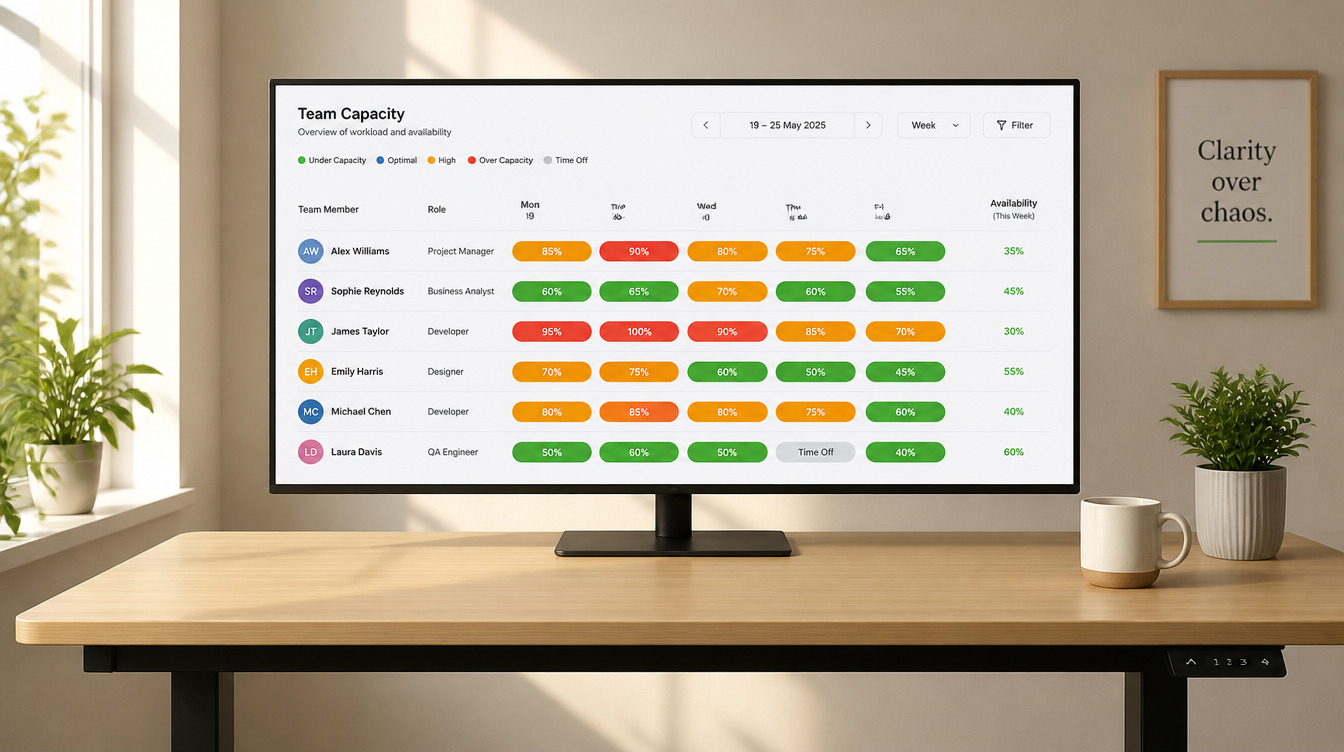
Neither is possible without seeing the shape of the curve first. Capacity planning provides that view, showing staff availability across a visual timeline with over-allocation and idle time surfaced, and longer term workload patterns that inform hiring decisions.
The useful exercise is not looking at next week. It is looking at the peak window from three months out and asking what could be moved into the trough that precedes it. That question only has an answer while there is still time to act on it.
Model the season with your own numbers
A capacity model built on estimated effort is a guess with a chart attached. Built on last year's actual hours by job type, it is a forecast.
This is where consistent job structure pays off. Where recurring compliance work runs from job templates that pre-configure phases, tasks, milestones, staff assignments and estimated hours, each cycle produces comparable data against the same structure. Last year's actuals become this year's estimates, refined annually.
Practices that rebuild each job from scratch every cycle never accumulate that history, and their capacity model stays a guess indefinitely.
Pressure two: advisory work absorbs the shock
The second pressure is less visible and more damaging to a growing practice.
Advisory and consulting work rarely has a statutory deadline. Compliance always does. When the two compete for the same person in the same week, compliance wins every time, and it is correct that it does.
The cumulative effect is that advisory work slips repeatedly, and the practice's most strategically valuable service line is the one that absorbs every scheduling shock. Clients notice. So do the staff who were hired to do advisory work and spend three months a year not doing it.
Protecting advisory bandwidth is a scheduling decision made before the season, not a resolution made during it. In practice it means allocating specific people to specific advisory commitments in the plan, and treating that allocation as fixed rather than as the flexible portion.
The alternative framing is worth stating plainly. If advisory time is whatever remains after compliance, then advisory capacity is zero during every peak, and the practice should plan on that basis rather than promising clients otherwise.
Pressure three: review capacity is the real constraint
The third pressure is the one most capacity models miss entirely, and it is frequently the actual bottleneck.
Preparation work can be distributed across a team. Review usually cannot, because it concentrates on a small number of senior people who are qualified to sign off. A practice can add three preparers and find that nothing moves faster, because everything still queues behind the same two reviewers.
Two things follow for how you plan.
Review time has to appear in the capacity model as scheduled work rather than as something senior staff fit around their other commitments. If it is not in the plan, it is invisible, and the plan will show a partner with available capacity who is in fact fully committed.
And review load has to be visible enough to be redistributed. Timesheet approvals allow approvers to be assigned to specific staff, with notifications on submission or a daily digest of what is pending. The assignment structure is where review load is either balanced or quietly concentrated on whoever is most conscientious about clearing their queue.
What a distributed team changes
For a practice with people across multiple offices, working remotely, or spread across time zones, two problems compound.
Informal load balancing stops working. In a single office, an experienced manager notices who looks overwhelmed and moves work around. Distributed, that signal disappears, and the first indication of overload is often a missed deadline or a resignation.
And people become invisible in both directions. Someone genuinely underused is as hard to spot as someone drowning, which means a practice can be simultaneously over capacity in one location and idle in another.
The response is that allocation has to be explicit rather than observed. A shared view of who is committed to what, visible to everyone rather than held by one person, is the only substitute for the social signals a distributed team no longer has.
Leave has to be in the same view
A capacity plan that does not know who is away will be wrong in exactly the weeks it matters most.
Leave management keeps requests, approvals and capacity in sync, with approvers seeing what needs actioning in one place. Requests flow into the capacity plan and approvals create the corresponding timesheet entries without separate admin.
For burnout specifically, this has a second function. A practice that can see who has not taken leave in an extended period has a leading indicator, and it is available before anything visible goes wrong.
Implementation without a false start
Three things determine whether a capacity planning implementation holds beyond the first quarter.
- Start with the season you can already predict, not with the whole practice. Model one upcoming compliance window properly, using last year's actual hours, and check the forecast against what happens. A model that proved accurate once earns the trust needed to expand it.
- Include non-chargeable work from the outset. Internal jobs can be created for activities such as leave, training, meetings and business development, with staff logging time against them as they would for client work, and reporting then showing utilization rates that account for all hours. A capacity plan that only counts client work will show availability that does not exist, and the people affected will know it is wrong immediately, which is how these implementations lose credibility.
- Review the plan against reality on a fixed schedule. Reporting provides system reports and a report builder for views specific to your practice, saved to favourites for repeated use. The comparison to run is planned against actual hours by person, monthly. Persistent variance in one direction means the model is wrong, and a model nobody corrects is abandoned within two cycles.
Capacity planning is a commitment discipline
The framing that makes this work is not that capacity planning protects your team, although it does.
It is that capacity planning changes what your practice is willing to commit to. A firm without a forward view says yes to work and discovers afterwards whether it had the capacity, which transfers the entire consequence of that decision onto the people delivering it. Burnout in a growing practice is very often the accumulated cost of commitments made without visibility.
A firm that can see three months out makes a different kind of decision. It can decline an engagement, delay a start date, or resource up in advance, and each of those is a legitimate business choice rather than an admission of limitation.
The workload was always going to arrive. What changes is whether anyone decides to accept it.
Model your next peak before it arrives
The most useful starting point is the next compliance window, built from last year's actual hours rather than estimates. WorkflowMAX offers a 14 day free trial if you want to set up a capacity view and test it against a season you already know the shape of. If you would rather discuss how to structure recurring jobs so the model improves each cycle, you can book a demo with the team.