


TL;DR
Phase-based architectural billing and subconsultant cost recognition run on two different clocks, and the gap between them means a practice frequently bills a phase complete before knowing what that phase cost. Purchase orders close the gap by recording a commitment at the moment of engagement rather than waiting for the consultant's invoice, which puts committed cost against the phase while the number can still influence something. This article sets out a commitment tracking framework built around that principle, covering how orders should be raised, tied to phases, and receipted against progressive consultant billing.
Two clocks that do not synchronise
An architectural practice bills on a schedule tied to its own progress. A phase reaches completion, an application for payment goes out, and the amount is a function of the agreed fee and the proportion of work delivered.
Subconsultants operate on their own schedule entirely. A structural engineer engaged in month two may deliver across months three to seven and invoice at intervals that follow their internal practice rather than yours. A certifier may bill on completion of an assessment that lands whenever the assessment lands.
The result is a persistent misalignment. At the moment you certify a phase as complete and bill for it, some portion of the consultant cost attributable to that phase has not been invoiced to you and therefore does not exist financially.
You are, at that moment, reporting a phase outcome you cannot yet calculate.
For a practice running a handful of small commissions, the gap closes quickly enough to be tolerable. On a large multi-phase project with five or six consultant engagements running concurrently, it does not. Costs continue arriving against phases that were billed and closed months earlier, and the practice discovers the true phase margin retrospectively, which is to say too late to do anything about it.
What a purchase order does that an invoice cannot
The distinction worth being precise about is between a commitment and a transaction.
When you engage a consultant for a defined sum, a commercial obligation exists immediately. Nothing has moved through your ledger, because no invoice has been issued, but the money is spoken for as certainly as if it had been.
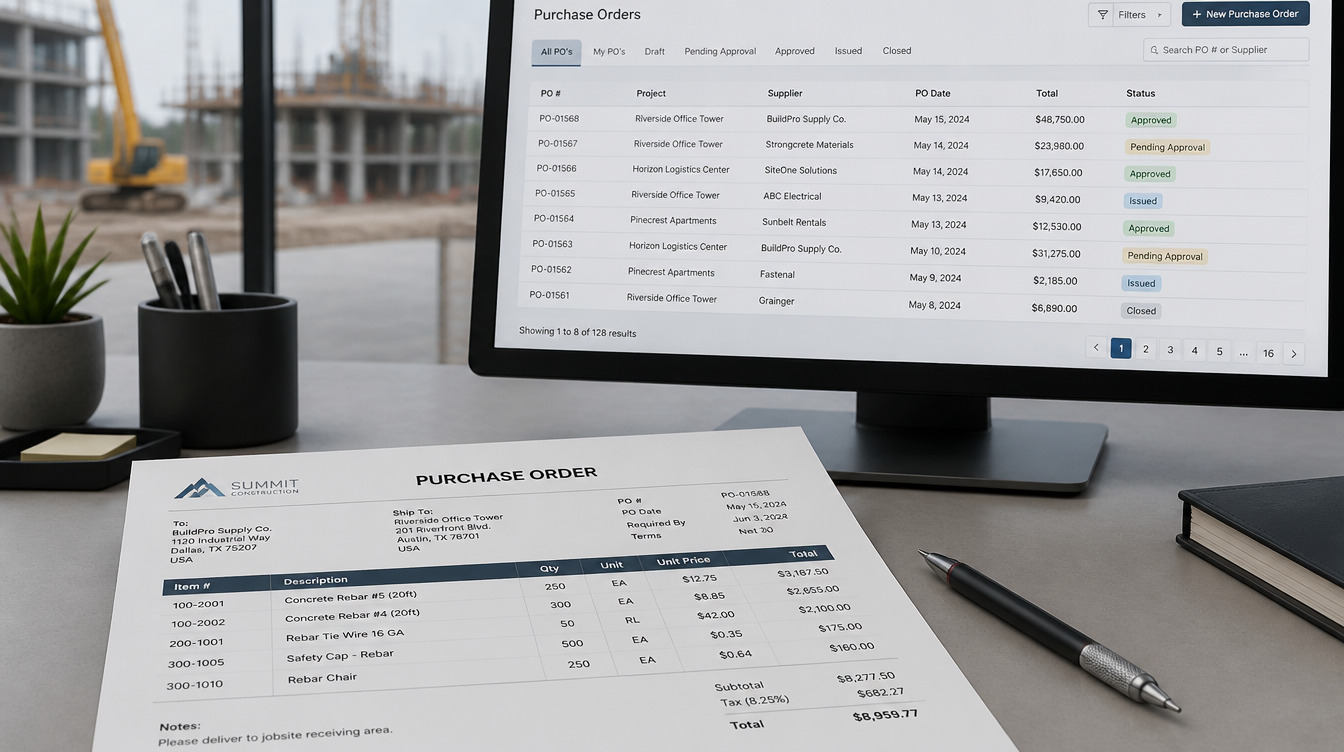
A purchase order is the instrument that records that obligation at the point it is created. That is its entire value in this context. It makes committed costs visible during the window between engaging someone and being billed by them, which is precisely the window in which phase billing decisions are made.
Purchase orders in WorkflowMAX keep supplier costs linked to the work they relate to from the moment the order is raised, with partial or full receipts recorded as goods and services arrive.
There is a technical detail here worth understanding, because it explains why this cannot be solved in your accounting system. Purchase orders do not sync to Xero or QuickBooks, for the sound reason that a request to buy is not a financial transaction. When an order is receipted, the resulting cost entry becomes a bill that flows through as an accounts payable item. The commitment lives in the job. The transaction lives in the ledger. Any framework that relies on the ledger alone is structurally incapable of seeing commitments, regardless of how well it is configured.
Building the commitment framework
Three practices turn purchase orders from an administrative step into financial control.
Raise the order at engagement, not at invoice
The most common way this framework fails is that orders are created when the consultant's invoice arrives, as a documentation exercise, rather than when the consultant is engaged.
Raised at engagement, a purchase order tells you something useful for months. Raised at invoicing, it tells you something you already knew, and the visibility window is lost entirely.
The rule to enforce is that no consultant begins work without an order in place. This is not bureaucratic caution. It is the only point at which the number is available before it becomes a fact.
Tie the order to the phase it belongs to
An order attached to a project is better than nothing. An order attached to the phase that will consume it is what makes phase-level billing decisions possible.
Where consultant scope spans multiple phases, which is usual, the engagement should be broken into orders that correspond to the phases they serve rather than raised as one lump. A structural engagement covering design development and documentation is two commitments with two phase allocations, not one number sitting ambiguously across the project.
In job management, phases hold their own tasks, milestones and estimated hours, and the job overview dashboard surfaces gross margin and job profitability. Phase-level cost allocation is what makes that margin figure meaningful rather than a whole-project average that conceals which phase actually lost money.
Use partial receipts to match progressive billing
Consultants frequently invoice progressively rather than on completion, which means the commitment reduces in stages.
Recording partial receipts against an order as work is delivered keeps the remaining commitment accurate. The order stops being a binary open or closed item and becomes a live figure showing what has been consumed and what is still outstanding.
That figure is the one to read before billing a phase. Committed but unreceipted cost on a phase you are about to certify as complete is a warning that the phase outcome is not yet knowable.
Reading phase profitability at the moment you bill
With commitments recorded and allocated, a phase can be assessed before the application for payment goes out rather than after.
The reading has three components. The fee attributable to the phase. The internal effort consumed, priced at your own rates. And the consultant and material commitment allocated to it, including the portion not yet invoiced.
That third component is the one the framework adds, and it changes the character of the decision. A phase showing acceptable margin on invoiced costs alone, with forty thousand in unreceipted consultant commitment attached, is not a phase performing acceptably. It is a phase whose result has not arrived.
Knowing this before billing has practical consequences. It informs whether reimbursable consultant costs have been captured completely for that phase. It flags whether a variation should have been raised earlier. And it prevents a practice from concluding that a project is tracking well on the basis of a partial cost picture, which is the error that leads to underpricing the next commission of the same type.
Invoicing then executes the billing on whatever basis the agreement specifies, supporting progress amounts, actual time and costs, quoted time and costs, or percentage of value, with phases invoiced separately. Approved invoices carry through to Xero or QuickBooks with account codes, tracking categories and tax rates mapped in advance.
Material orders and reimbursables
Consultant fees are the largest commitment category for most practices, but the same mechanism applies to everything ordered against a project.
Printing and document reproduction, survey work, model making, specialist testing, travel booked against a specific site visit. Each is an obligation created before it becomes a bill, and each is typically recoverable from the client under the agreement.
The recovery is where practices lose money quietly. A reimbursable cost that was never attached to the project cannot be billed to the client, and nobody notices, because the absence of a cost is invisible in a way that an unexpected cost is not.
Raising orders for these items produces a record at the moment of ordering, which means the reimbursable schedule is assembled from the project rather than reconstructed from receipts and memory when the invoice is being prepared.
What the framework changes about the consultant conversation
There is a secondary benefit that has nothing to do with reporting.
A practice that raises an order at engagement has, by definition, agreed a scope and a sum with the consultant in writing before work begins. That is a different relationship from one where the engagement is verbal and the sum is discovered on the invoice.
Where a consultant's invoice exceeds the order, the discrepancy is visible immediately and specifically, and the conversation concerns a defined difference rather than a general sense that the fee seems high. Where a consultant's scope expands during a project, which happens for legitimate reasons, the expansion is priced as a change to the order rather than absorbed into a larger final number.
Over time, reporting makes the pattern visible across projects through job profitability reports and a report builder for views specific to how your practice categorizes work. Which consultant engagements consistently exceed their orders. Which disciplines are systematically underestimated at engagement stage. That is procurement intelligence, and it only exists if commitments were recorded as commitments.
The visibility window is the whole point
Every element of this framework exists to address a single structural problem, which is that architectural practices bill on their own timetable and incur consultant costs on somebody else's.
You cannot align the two clocks. Consultants will continue to invoice when they invoice, and your billing schedule will continue to follow your phases. What you can do is stop waiting for the second clock before you read the number.
A commitment recorded at engagement gives a practice several months of advance sight on a cost that would otherwise materialise after the relevant decisions have been taken. That window is where every useful action lives: adjusting a phase, raising a variation, questioning a consultant scope, or simply pricing the next project with an accurate view of what this one cost.
Practices that skip the framework are not making worse decisions. They are making the same decisions later, with information that arrived after it could change anything.
Map the commitments on a live project
Take a project currently in documentation, list every consultant and material engagement, and check how many exist as a recorded commitment rather than an expected invoice. The difference is your current visibility gap. WorkflowMAX offers a 14 day free trial.