

Migrating to a new job management platform feels risky when projects are already in motion. A phased approach focused on workflow alignment, data consistency, and team adoption lets firms make the transition without losing delivery momentum.
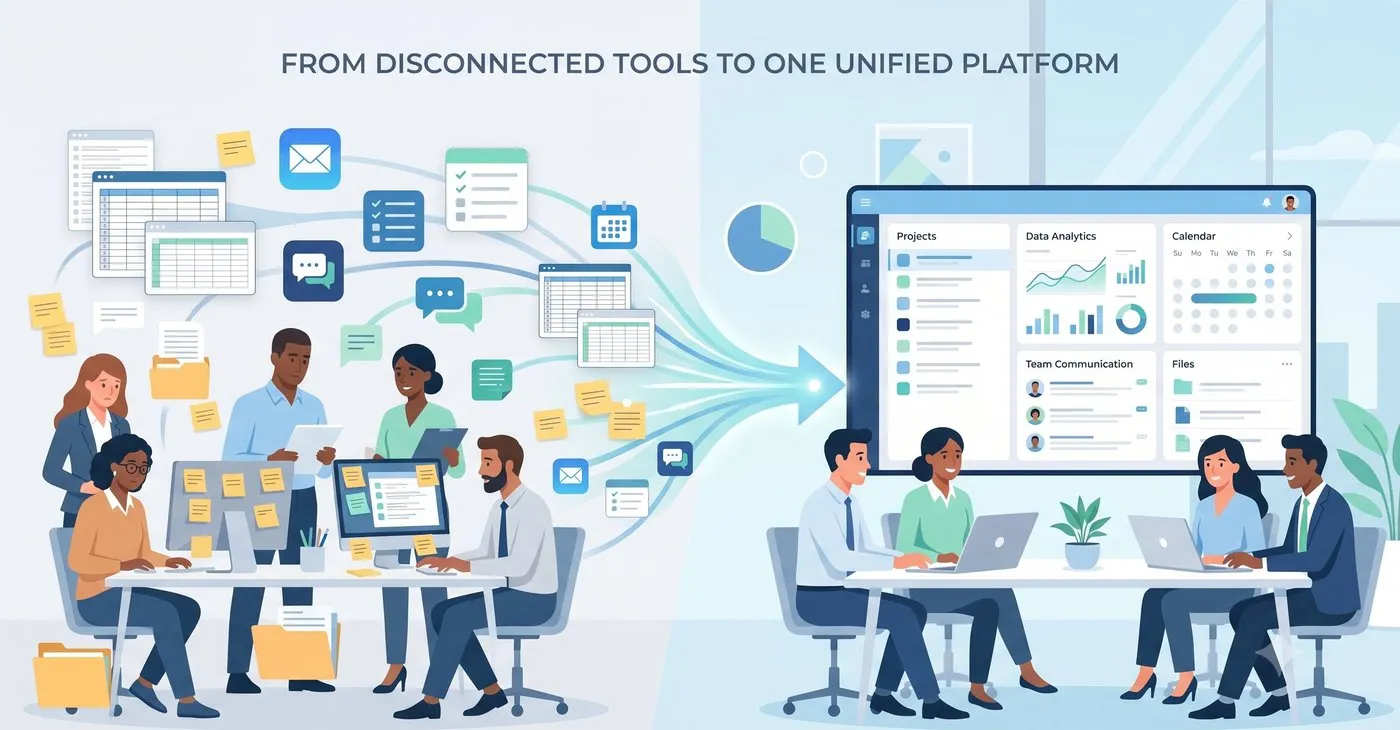
As firms grow, their systems tend to evolve by accident rather than by design. A time tracking tool gets added here, a separate invoicing system there, project tracking moves into spreadsheets. Each decision made sense at the time, but the cumulative result is a fragmented operational environment where data lives in multiple places, reconciliation is manual, and the gap between what is happening on a project and what the numbers show keeps widening.
The case for consolidating into a single job management platform is usually clear. The concern is how to get there without disrupting the work already in progress.
Start by mapping where disconnection is actually costing you
Before touching any system, understand exactly where the fragmentation is creating problems. Not all disconnection carries the same cost.
- Re-entering data between systems is inefficient and time-consuming
- Losing visibility into project financial performance mid-delivery is a profitability risk
- Missing the window to invoice accurately because billing is disconnected from tracked work affects cash flow directly
Map your current workflow from lead to invoice and identify the specific points where information falls out of the system, requires manual handling, or produces unreliable outputs. That map tells you where a single platform will deliver the most immediate value and helps you prioritise what to configure first.
Standardise workflows before you migrate anything
The most common mistake in platform migrations is moving broken processes into a new system and expecting the technology to fix them.
It doesn't.
If different team members handle project setup, time tracking, or invoicing differently, those inconsistencies will carry over and become harder to address once the migration is underway.
Before migrating, define standard workflows for how opportunities are captured, how estimates are structured, how jobs are set up, how time is recorded, and how invoices are generated. WorkflowMAX is built around a connected sequence of:
- Lead Management
- Estimating and Quoting
- Job Management
- Time Tracking
- Invoicing
Mapping your standardised processes to that sequence before you begin guarantees the migration reinforces good habits rather than embedding existing inconsistencies.
Move new projects first, then transition active ones in phases
Attempting to migrate everything simultaneously is the most reliable way to create confusion, data inconsistencies, and delays. A phased approach is significantly lower risk.
Start by running all new projects through WorkflowMAX from the outset. This lets teams build familiarity with the system on work that is not already mid-delivery. Active projects can then be transitioned progressively, with historical data retained separately if needed. During the overlap period, Reporting and Dashboards provides real-time job financial summaries across active projects, giving you visibility into performance even while the transition is still in progress.
Integrate your accounting system early
Financial misalignment during migration is one of the highest-risk outcomes. If project data and accounting data fall out of sync during the transition, the reconciliation work on the other side can be significant.
Integrate with Xero or QuickBooks early in the process rather than treating it as a final step. When invoicing data flows directly between systems from the start, financial records stay consistent throughout the migration and billing continuity is maintained without manual intervention.
Centralise documentation as part of the transition
Migrations surface a documentation problem that was always there but easy to ignore: project files scattered across legacy systems, shared drives, and email threads with no reliable connection to the projects they belong to. Moving to a new platform is the right moment to fix this rather than carry the problem forward.
Document Management in WorkflowMAX links all project files directly to their respective jobs. Combined with estimating and quoting for scope definition, job management for delivery tracking, and reporting for confirming completion, the result is a structured project record where nothing critical gets lost in the transition.
Invest in team adoption, not just settings
An optimized system with the right settings will still fail if teams revert to old tools out of habit or uncertainty.
Adoption challenges are rarely about the platform itself. They are about clarity: people need to understand not just how to use the system, but why the new workflows are structured the way they are and what they are expected to do differently.
Focus training on workflows rather than features. When teams understand the logic of how a lead becomes a quote, a quote becomes a job, and a job becomes an invoice, the individual features make more sense in context. Use Customisation to align the system with your existing processes where possible, which reduces friction and shortens the learning curve.
The transition is an opportunity, not just a risk
Migrating from disconnected tools to a single platform is disruptive by definition. But firms that approach it with a structured plan, standardised workflows, and a phased timeline consistently find that the transition period is shorter and less painful than anticipated, and that the operational clarity on the other side justifies the effort.
WorkflowMAX connects end-to-end operations, including Estimating and Quoting, Time Tracking, and Invoicing into a single cohesive workflow, giving firms a foundation that supports better decisions, more reliable financial control, and a system that scales as the business grows.
.jpg)