


{"@context":"https://schema.org","@graph":[{"@type":"CollectionPage","@id":"https://www.workflowmax.com/blog","url":"https://www.workflowmax.com/blog","name":"WorkflowMAX Blog","description":"Articles on job profitability, time tracking, quoting, invoicing and managing service firms with WorkflowMAX.","isPartOf":{"@id":"https://www.workflowmax.com/#website"},"about":{"@id":"https://www.workflowmax.com/#organization"}},{"@type":"BreadcrumbList","itemListElement":[{"@type":"ListItem","position":1,"name":"Home","item":"https://www.workflowmax.com/"},{"@type":"ListItem","position":2,"name":"Blog","item":"https://www.workflowmax.com/blog"}]}]}

WorkflowMAX Blog

Welcome to our blog

Articles, resources and content designed to boost your productivity, profitability and performance. Subscribe to the get the latest resources right at your inbox!

Thank you! Your submission has been received!
Oops! Something went wrong while submitting the form.

TL;DR: As firms grow, coordination between design, delivery and finance teams often becomes harder than the work itself. Information gets duplicated, time is captured inconsistently, project changes are missed, and invoicing can lag behind delivery. The answer is not more meetings or more spreadsheets, but a connected operating model built on consistent processes, visible job data and reliable financial workflows.

Scaling internal coordination across design, delivery, and finance teams

Professional services firms rarely struggle because their teams lack talent or dedication. More often, the friction lies in the quiet spaces between those teams, the handovers from scoping to delivery, the jump from finishing a project to sending a bill, and the constant effort to keep project activity in sync with financial oversight. It’s in these transitions where even the best teams can feel the most strain.

For architects, engineers, accountants, designers and consultants, those gaps carry real consequences. A missed scope change can affect margins. Poor time capture can distort project visibility. Inconsistent documentation can create compliance risk. Delayed invoicing can affect cash flow. And when delivery teams and finance teams are working from different versions of the truth, decisions become slower and less reliable.

That is why scaling internal coordination across design, delivery, and finance teams matters. As firms take on more jobs, more staff and more complexity, they need structured systems that connect commercial decisions, project execution and financial management. The goal is not simply to move faster. It is to improve visibility, protect profitability and maintain control as operations scale.

Why coordination breaks down as firms grow

Growth tends to expose process weaknesses that were manageable in a smaller firm. When a business is running a handful of jobs, informal updates and manual workarounds may seem sufficient. Once job volumes increase, those same habits can create friction.

Different teams measure success differently

Design or scoping teams are focused on defining the work clearly and winning the job. Delivery teams are focused on meeting deadlines, managing resources and responding to client changes. Finance teams are focused on cost capture, invoicing accuracy and revenue timing.

None of those priorities are wrong. The problem arises when each function works in isolation.

Typical symptoms include:

  • estimates that do not translate cleanly into live jobs
  • time entries that are incomplete or delayed
  • supporting documents stored in multiple places
  • invoices raised without full context
  • reporting that is technically available but operationally hard to trust

In practice, this means the firm can be busy without being in control.

Scaling exposes weak handovers

Many operational problems appear at handover points rather than within teams themselves. For example, a quote may win approval, but key assumptions may not be easy for delivery staff to reference later. A project manager may know a variation has occurred, but finance may not see the impact until invoicing is due. A consultant may complete billable work, but if Time tracking is delayed, the financial picture remains incomplete.

This is where structured workflows matter. WorkflowMAX supports those workflows through connected capabilities rather than a single catch-all tool. Estimating and Quoting sets the commercial baseline. Job Management carries that baseline into delivery. Time Tracking records actual effort. Document Management stores supporting records. Invoicing turns completed work into revenue. Reporting and dashboards provide ongoing visibility.

Building a shared operational backbone

Better coordination starts with one principle: all teams need access to the same job reality.

That does not mean every person needs the same screen or the same detail. It means the firm needs consistent information flowing from first quote to final invoice.

Use estimating as the operational starting point

In many firms, estimates are treated as sales documents only. That creates problems later, because delivery teams may start work without a clear operational reference point.

Estimating accuracy improves when Estimating and Quoting is used not just to price work, but to define the scope, assumptions and commercial structure that delivery and finance teams will rely on later.

A stronger workflow typically looks like this:

Create clear estimates before work begins

Estimating and quoting should define:

  • the scope of services
  • expected stages or task groupings
  • commercial assumptions
  • pricing structure
  • likely resource effort

That matters because delivery teams need a usable baseline, not just an approved price.

Carry approved detail into live delivery

Once work is won, Job Management should become the live operating environment for the job. This is how the firm moves from proposed work to active control. Rather than relying on separate notes or disconnected spreadsheets, the job structure reflects what was sold and what now needs to be delivered.

Connect actual effort back to plan

Time tracking provides evidence of how work is progressing against that original commercial expectation. This is essential for firms managing utilisation, budget adherence and cost tracking.

Standardise job delivery without losing flexibility

As firms scale, they often face a tension between consistency and adaptability. Standard processes improve control, but overly rigid systems can frustrate teams dealing with varied job types, client requirements or sector-specific compliance needs.

This is where operational efficiency needs to be carefully designed.

Create consistent job structures

Job Management helps firms standardise the way work is organised across teams. That consistency matters because it gives delivery and finance teams a shared frame of reference. Jobs can be set up in a repeatable way, helping managers compare performance more easily and reducing the risk that key steps are missed.

Adapt workflows to fit the firm

The real power of a tailored operational model lies in its ability to adapt. Rather than forcing every team into a rigid, generic structure, true customization allows a firm to shape the system around its unique culture and the way its people actually work.

That can support:

  • different service lines
  • varying project stages
  • team-specific data requirements
  • internal approval preferences

This is particularly valuable for firms balancing standard operating procedures with the practical realities of different disciplines or client engagements.

Keep documents connected to the job

Document management is central to maintaining control as project volumes rise. Drawings, client instructions, scope records, supporting files and revisions need to remain accessible in context.

For firms operating in regulated or highly documented environments, this matters. It reduces the chance that critical records are buried in inboxes or personal folders and improves readiness when information needs to be reviewed.

Strengthen cost control before margin slips

Profitability problems often start quietly. A job looks healthy at quote stage, work begins, changes accumulate, and only later does the firm discover that the margin has narrowed.

Cost control depends on timely, connected information rather than end-of-month hindsight.

Capture time and activity consistently

Time tracking is one of the most important controls available to professional services firms. It supports accurate billing, but it also supports operational judgement. Without reliable time data, it is difficult to understand effort by job, identify overruns or assess delivery efficiency.

The value is broader than payroll or timesheets. Time tracking helps teams answer practical questions such as:

  • Are we using more hours than planned?
  • Which stages are absorbing unexpected effort?
  • Are client changes affecting profitability?
  • Is the current fee still commercially sound?

Turn job activity into financial oversight

Job Management and Time tracking together create the foundation for cost control. Reporting and dashboards then translate that operational data into something leaders can act on.

Reduce invoicing delays

In many firms, invoicing is delayed not because finance is slow, but because delivery information arrives late or incompletely. When project data, time records and supporting notes are fragmented, finance teams spend time chasing context instead of raising invoices.

Invoicing works best when it sits within a connected process:

  1. the job is structured clearly through Job Management
  2. time and work are recorded through Time Tracking
  3. supporting files are available through Document Management
  4. invoices are raised through Invoicing
  5. financial records are aligned through Integrations with Xero/QuickBooks

That step-by-step workflow is what turns coordination into cash flow discipline.

Improve compliance visibility across teams

Compliance is often treated as a separate responsibility, but in professional services firms it is usually shaped by everyday operational discipline. Good compliance outcomes rely on clear records, consistent processes and traceable decisions.

Make records easier to find and review

Document management improves control by keeping project records accessible and organised. That supports internal reviews, client queries and audit readiness. It also reduces the operational risk that key information sits outside the formal job record.

Use reporting to spot risks earlier

The benefit of proactive oversight is delivered through Reporting and dashboards, not through an invented “compliance centre” or similar label. Reporting and dashboards help leaders monitor job status, financial progress and operational trends using live business data.

That matters because emerging issues are easier to address when teams can see them early, whether the issue is delayed time capture, underbilled work or jobs drifting from their original assumptions.

Support accountable handovers

Compliance visibility also improves when handovers are structured. Estimating and Quoting, Job Management and Document Management together help create a clearer chain from agreed scope to active delivery records. That reduces ambiguity when teams change hands or when a finance review needs to understand why a job looks the way it does.

Structured coordination is what makes growth sustainable

Professional service firms scale sustainably through systems that provide visibility, traceability, and financial management, rather than effort alone. Internal coordination across design, delivery, and finance teams is a critical operational factor impacting key areas like estimating, cost control, compliance, and profitability.

WorkflowMAX delivers this structure, offering an operational backbone that supports the full job lifecycle (from Estimating and Quoting through to Invoicing and Reporting and dashboards), which makes growth manageable by strengthening project visibility and improving financial control.

Explore WorkflowMAX.

TL;DR: As architecture firms diversify into advisory, sustainability, interiors, project management or specialist consulting, operational complexity increases faster than revenue if systems stay fragmented. The core challenge is not offering more services; it is managing different scopes, pricing models, delivery workflows and billing requirements without losing visibility or margin. The most effective response is to standardise how work is estimated, delivered, tracked and invoiced. WorkflowMAX supports that clarity and control through Estimating and Quoting, Job Management, Time Tracking, Invoicing, Reporting and dashboards, Document management, Customisation, Lead management, and Integrations with Xero/QuickBooks.

Diversification can be a smart growth strategy for architecture firms. It can open new revenue streams, deepen client relationships and reduce dependence on a narrow project mix.

But it also introduces more moving parts into day-to-day operations. A firm that once delivered straightforward design services may now be handling feasibility studies, compliance documentation, interior packages, stakeholder engagement, contract administration or strategic advisory alongside core design work.

That shift changes the operational burden. Different services often involve different fee structures, approval stages, documentation needs, staffing patterns and invoicing rules.

Without structured systems, firms can quickly find themselves dealing with patchy project visibility, inconsistent cost tracking, delayed billing and a higher risk of missed compliance steps. Managing operational complexity as architecture firms diversify services therefore becomes as much an operational discipline as a strategic one.

Why service diversification creates operational drag

The opportunity is obvious: more services can mean more value for clients and stronger revenue resilience for the firm. The problem is that every new service line adds another layer of coordination.

A diversified architecture practice may be juggling:

  • fixed-fee concept design
  • hourly advisory work
  • staged documentation and approvals
  • consultant coordination
  • variation-heavy project delivery
  • multiple invoice triggers across one client relationship

Every project requires precise scoping, tracking, and billing. When teams rely on disconnected spreadsheets and emails, leadership loses sight of the portfolio’s health. WorkflowMAX replaces this fragmentation with a unified operating structure, integrating job management, time tracking, and invoicing into a single, real-time dashboard.

A practical sign of operational drag is when firms cannot answer simple questions quickly: Which services are most profitable? Which jobs are drifting outside scope? Which teams are over-serviced? Which invoices are ready now? Those answers depend on structured data capture, not intuition.

Managing operational complexity as architecture firms diversify services

Diversification works best when firms standardise the commercial and delivery backbone behind every service, even if the work itself remains flexible.

Standardise scope before delivery begins

Many complexity problems begin before the job starts. A firm wins work with a broad proposal, then allows delivery teams to interpret the scope differently. As more services are added, that ambiguity compounds.

A better approach is to create a consistent estimating workflow:

  1. define the service components clearly
  2. structure assumptions and exclusions
  3. estimate time and costs against the proposed work
  4. convert the approved scope into the live job record

This is where Estimating and Quoting plays a central role. WorkflowMAX states that users can include time estimates and invoicing in quotes to price services accurately. That matters for architecture firms because diversified services often require separate assumptions and charging logic within one engagement.

Customisation strengthens this further. WorkflowMAX officially supports custom billing rates, custom fields, custom print templates and custom reports. That means firms can adapt the system to reflect different service types, client requirements or charging structures without inventing separate processes outside the platform.

Build a repeatable job structure for different service lines

Once work is won, operational control depends on how jobs are set up. A diversified firm needs a repeatable way to manage projects that may include design, advisory, documentation and post-approval support under one client account.

This is delivered through Job management, which WorkflowMAX describes as supporting project and task tracking, job scheduling and improved staff capacity planning. The help centre also confirms Job Manager is used to create new jobs and work with existing ones.

For architecture firms, the best practice is to create a standard job framework that includes:

  • consistent task stages for each service line
  • named milestones for approvals and handovers
  • clear ownership across staff and subcontractors
  • rules for when a variation becomes a billable change

That kind of structure reduces operational friction. It also supports compliance visibility because required stages and documentation can be embedded into the workflow rather than left to memory.

Improving cost control when teams deliver mixed service models

Diversification often exposes margin leakage. Advisory work can overrun. Small variations can accumulate unnoticed. Senior staff may spend too much time on tasks originally scoped for more junior team members.

Capture effort consistently

The starting point for cost control is accurate time capture. WorkflowMAX’s Time tracking feature is designed to capture chargeable time, and the help centre confirms time can be entered through quick time entry and daily or weekly timesheets.

That matters because diversified architecture services rarely consume effort evenly. Early-stage strategy work may be light on documentation but heavy on senior input. Delivery work may be the reverse. Without disciplined time capture, firms cannot compare estimated effort against actual effort in a meaningful way.

The broad benefit of stronger cost control is supported by several confirmed components:

  • accurate cost capture through Time tracking
  • project and task oversight through Job management
  • financial summaries and dashboard visibility through Reporting and dashboards
  • accounting reconciliation through Integrations with Xero/QuickBooks

Turn job data into usable financial decisions

Cost tracking alone is not enough. Leadership also needs usable visibility. WorkflowMAX’s Reporting and dashboards feature provides a customisable dashboard with an at-a-glance view of job-related tasks, business performance and cash flow, while its job financial summary reporting is positioned as a way to understand where profit is being made and lost.

For firms diversifying services, that visibility helps answer practical questions such as:

  • whether a new advisory service is genuinely profitable
  • whether a fixed-fee package is being over-serviced
  • whether certain client types generate more write-offs
  • whether project teams are meeting billing expectations

That is how “full project visibility” should be understood here: not as a vague promise, but as the combined effect of Reporting and dashboards, Job Management, Time Tracking and accounting integrations working together.

Strengthening compliance visibility and documentation control

As firms diversify, documentation obligations often expand. Different services may require different approvals, records, correspondence trails or supporting files. The risk is not only inefficiency; it is inconsistency.

WorkflowMAX’s Document management feature supports centralised storage for project files, including emails and attachments linked to the correct client and job. Its feature pages also note accessibility from a single location and integration with document systems such as Dropbox, Google Drive and Box.

For architecture and consulting environments, that supports a more controlled workflow:

  1. store key project files against the relevant client and job
  2. keep related emails and attachments with the same record
  3. make documents easier to retrieve during reviews, handovers or disputes
  4. reduce the risk of teams working from outdated or scattered information

Compliance visibility is also improved when Customisation is used to add custom fields or tailored reports for the information a firm needs to track. WorkflowMAX officially supports custom fields and custom reports, which can help firms record service-specific requirements in a structured way.

Connecting business development to delivery without losing momentum

One reason diversification becomes messy is that firms manage pipeline activity in one place and operational delivery in another. That gap creates rework and weak handovers.

WorkflowMAX’s Lead management feature is designed to track leads, proposals and the sales pipeline from one place, with category-based forecasting, activity tracking and lead templates for more consistent follow-up.

For diversified firms, this is useful well before a project starts. It allows teams to build a clearer picture of the likely service mix coming into the business and the value attached to it. That supports better resourcing and commercial discipline, especially where different services carry different delivery demands.

The operational goal is not simply “pipeline visibility”. It is a workflow:

The firms that scale best build systems, not just service lines

Managing operational complexity as architecture firms diversify services is ultimately about discipline. New services do not create value on their own. Value appears when firms can scope work accurately, control delivery, maintain documentation standards, track costs properly and invoice with confidence.

That is why structured systems matter. WorkflowMAX provides that operational backbone through named features that support quoting, job delivery, document control, time capture, reporting and financial integration. For architecture firms aiming to grow without sacrificing visibility or profitability, that kind of structure makes diversification easier to manage and easier to scale.

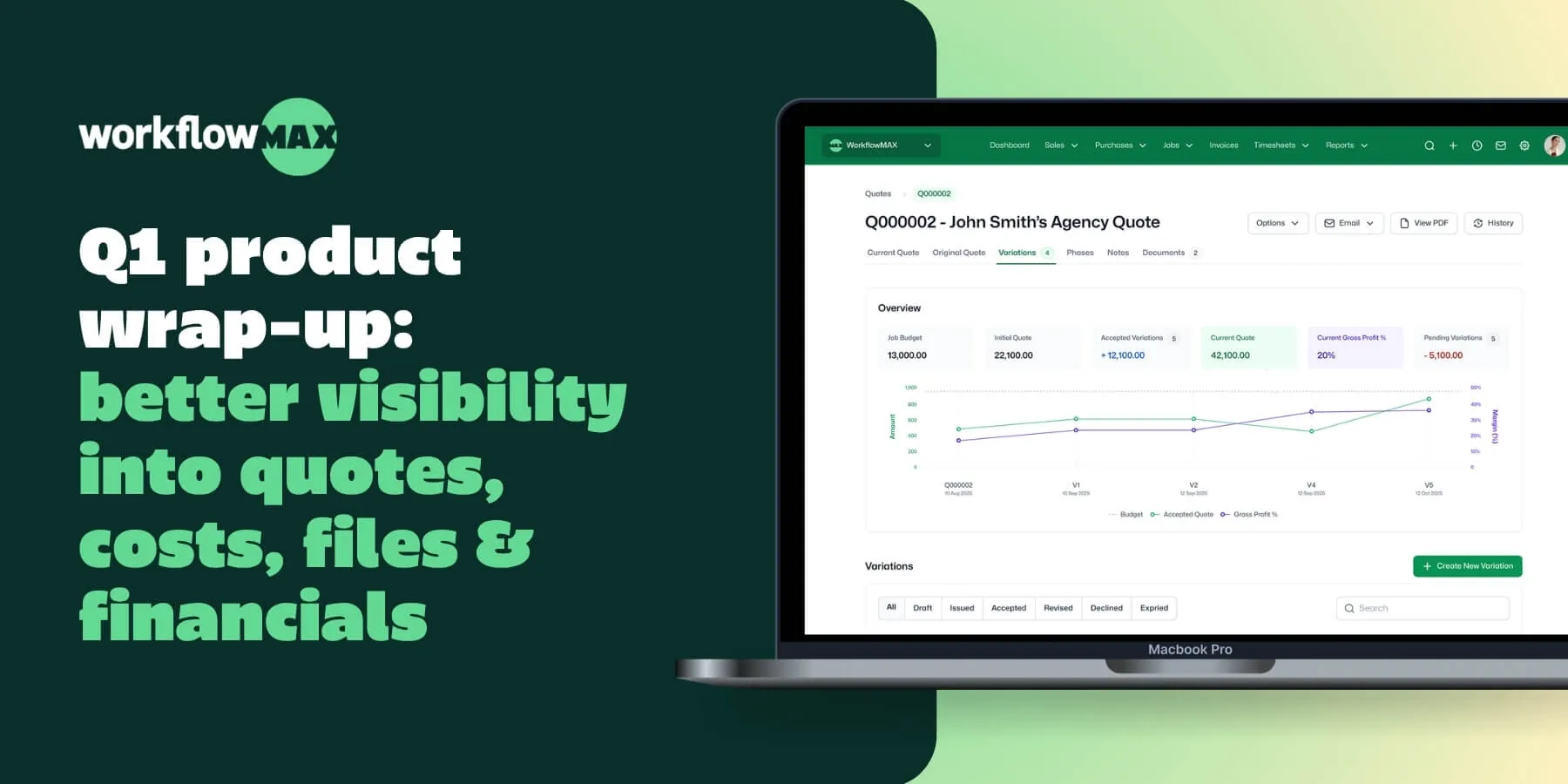
This quarter was about getting you the information you need, where you need it. Quote Variations gives you a clear audit trail when scope changes. The SharePoint Integration puts your project files in one place. AI Report Insights surface what matters in your financial reports.  And API v2 is now generally available for everyone.

📋 Quote Variations - Track every scope change without losing the original

The problem: Projects rarely go exactly to plan. Scope creep, clients add requirements, budgets shift. But when you update the original quote to reflect those changes, the paper trail disappears - and it's harder to see what was actually agreed at the start.

What's new: Quote Variations captures every scope change as a separate variation, sitting alongside the original quote. You get a clear, chronological record of what changed, when it changed, and what it means for the budget.

Why it matters: No more "what did we agree on?" conversations. You have a complete audit trail from first quote to current project status - useful for client conversations and for protecting your margin.

Currently in beta for Advanced plan customers.

Learn more →


📁 Microsoft 365 SharePoint Integration - One place for every project file

The problem: Your team is uploading documents to SharePoint, emailing files back and forth, and hunting through folder structures just to find the latest version. It slows everyone down and creates version confusion.

What's new: SharePoint Integration connects your project documents directly inside WorkflowMAX, synced with SharePoint. Upload from either side, and everything stays in sync. You can even email documents in via Collaboration Manager.

Why it matters: Every version, from every collaborator, in one place – without asking your team to change how they work. Files go into WorkflowMAX or SharePoint; everyone sees the same thing.

Currently in beta for Premium + Advanced plan customers.

Learn more →


🤖 AI Report Insights - Find what matters in your reports, automatically

The problem: You run the reports. Then you spend the next 20 minutes scrolling through rows of data trying to spot what's changed, what looks off, and what actually needs your attention.

What's new: AI Report Insights does that scanning for you. Run any custom report - invoices, WIP, profitability - and AI automatically flags what's changed, what looks unusual, and what needs action.

Why it matters: Less time reading numbers, more time acting on them. The exceptions come to you, instead of you having to hunt for them.

Currently in beta for Advanced plan customers.

Learn more →

🔗 API v2 - Now live for everyone

What's new: API v2 is out of beta and available to everyone. Every v1 endpoint is on v2, and as new WorkflowMAX features ship, they're available via API faster – giving you broader coverage and deeper access to your data as the platform grows

Why it matters: Whether you're building custom reports, connecting to your CRM, or automating workflows between tools – v2 gives you more endpoints to work with, and that coverage grows with every feature we ship.

Available on all plans.

Learn more →

What's coming this month

📆 Capacity Planning - Plan capacity at a glance  

The problem: You’re trying to plan work in advance, but availability lives in a spreadsheet (or someone’s head). By the time you realise someone’s overbooked, deadlines are already slipping and you’re reshuffling jobs at the last minute.  

What's new: Capacity Planning gives you drag-and-drop resource scheduling with real-time visibility into who’s available and where work is over-allocated - so you can balance workloads before timelines slip.  

Why it matters: Fewer surprises, less firefighting, and a clearer view of what your team can actually take on - before you commit. 

Available for beta later this month on Advanced plans.

Register for early access →

💰 Advanced WIP Management - Stop guessing what's behind the number

The problem: You look at the WIP balance on a job and have no idea what's driving it. Is it timesheets? Costs? A deposit? Getting to the answer means digging through multiple places.

What's new: Advanced WIP adds a dedicated WIP tab to every job, breaking the balance down into individual ledger entries - timesheets, costs, and deposits all in one view. Search, filter, sort, write off entries, and export to CSV for offline analysis.

Why it matters: The detail is right there, inside the job. No more guessing, no more cross-referencing across reports.

Available for beta later this month on Advanced plans.

Register for early access →

Here's a taste of what we're working on:

  • eQuotes - send quotes directly to clients for digital review and sign-off. They receive it, review it, approve it. No PDFs, no back-and-forth.
  • Multi-Currency Invoicing - invoice in your client's currency and let WorkflowMAX handle the conversions automatically. Accurate international billing without the manual work.
  • AI Expense Extraction (web) - upload a receipt and AI pulls the merchant, amount, and date instantly. Already in beta on mobile, with the desktop version on its way.

We can't wait to see how you put these to work. As always, keep the feedback coming - it directly shapes what we build next.

TL;DR: As agencies grow, operational visibility often breaks down because information becomes scattered across quotes, jobs, timesheets, documents, invoices, and finance systems. The result is slower decisions, weaker cost control, and more surprises at month-end. The fix is not more reporting after the fact, but a connected operating model from lead to quote to job to invoice. Growth is meant to create momentum. In many agencies, it also creates fog.

What worked when a firm had a handful of clients and a close-knit team started to break down as more people, projects and delivery stages entered the picture. A studio director can no longer keep the whole pipeline in their head. Project leads stop seeing the full financial picture. Finance teams inherit incomplete or delayed information. Suddenly, operational visibility becomes a daily challenge rather than a management advantage.

This matters because agencies do not just sell output. They sell time, expertise, scope, responsiveness and trust. When visibility weakens, profitability and client confidence usually follow. Partner interviews in WorkflowMAX’s research repeatedly point to the same issue: growing firms need visibility from initial enquiry through budgeting, job delivery, invoicing and reporting, rather than a patchwork of tools and spreadsheets.

Why operational visibility gets harder as agencies grow

Operational visibility sounds like a reporting problem, but it usually starts as a workflow problem.

In a smaller agency, the path from quote to job to invoice is often informal. People can chase missing details in Slack, ask finance for an update, or rely on a senior manager’s memory. As the agency grows, that stops being reliable. More leads enter the pipeline. More scopes evolve mid-project. More staff log time. More documents need to be found. More invoices depend on accurate delivery data.

The problem is not simply that there is “too much information”. It is that the information sits in different places and arrives at different times. The struggle for many service-based businesses is the 'data disconnect.' By consolidating the chaos of spreadsheets and manual tracking into a single source of truth, WorkflowMAX ensures that firms can finally see the real-time link between their team's effort and their project's profitability.

Common symptoms include:

  • Quotes that do not match the eventual delivery model
  • Time captured late or inconsistently
  • Project documents stored outside the job record
  • Invoices delayed because delivery and finance are out of sync
  • Reports that explain what happened last month, but not what needs attention today

For agencies, this is where scale starts to feel messy.

Why growing agencies struggle with operational visibility at every stage

Operational visibility usually breaks in stages, not all at once.

Lead and quote visibility gets lost first

Many firms think visibility begins when a job starts. In reality, it starts earlier.

If sales activity, scope assumptions and quoting decisions are not clearly captured, delivery teams inherit ambiguity from day one. That is why visibility at the front of the process matters. Lead Management helps teams keep track of opportunities and next steps, while Estimating and Quoting creates a clearer commercial starting point for the work that follows. Together, those features reduce the handover gap between business development and delivery.

This is especially important for agencies handling a mix of retained, fixed-fee and ad hoc work. If the original quote structure is vague, operational confusion shows up later as time overruns, billing friction and scope disputes.

Job visibility breaks when delivery becomes fragmented

As teams expand, jobs gain more moving parts: tasks, deadlines, dependencies, contributors and client requests.

This is where Job Management becomes central. Rather than treating job progress as something people discuss in meetings, the aim is to manage jobs, tasks and people from one place and track progress against agreed timelines. That does not solve every delivery issue on its own, but it gives firms a shared operational record. WorkflowMAX’s partner interviews consistently describe the value of having every live job known about in one place rather than buried in spreadsheets or separate tools.

Financial visibility breaks when time and invoices drift apart

A growing agency can look busy while losing control of cost tracking.

This is why operational visibility must include money, not just work status. Time Tracking captures delivery effort as work happens. Invoicing turns approved work into billable output.

Reporting and dashboards translate that activity into job-level financial summaries and broader business insights. When those pieces are disconnected, leadership ends up reacting too late. When they work together, agencies are better placed to see whether a job is drifting before it becomes a margin problem.

The real cost of poor visibility

Poor project visibility does not usually announce itself dramatically. It appears as waste.

Teams re-enter data. Managers chase updates. Finance waits for missing details. Senior staff make judgement calls without enough context. By the time a problem shows up in monthly numbers, the operational cause may already be buried.

The impact often shows up in five places.

1. Slower decision-making

When job data, documents, time entries and billing details are spread across systems, managers spend more time validating information than acting on it.

2. Weak cost tracking

If Time Tracking is incomplete or disconnected from Job management, agencies struggle to understand the true delivery cost of work. That makes pricing, staffing and scope control harder. WorkflowMAX’s internal narrative work frames job profitability as the missing metric in many service firms because time, cost and billing data are often viewed separately rather than together.

3. Compliance risk through inconsistency

For agencies, compliance visibility is rarely one dramatic feature. It comes from consistent records, clear documentation and accurate financial handoff. In WorkflowMAX terms, that means using Document management to keep job-related files accessible, Reporting and dashboards to surface relevant operational and financial information, and Integrations with Xero/QuickBooks to connect delivery records with accounting processes.

The source-of-truth guidance is clear that “compliance” should be explained through those named features, not presented as a standalone product claim.

4. Delayed invoicing

If finance has to reconstruct what happened on a job, invoicing slows down. Cash flow then depends on admin effort rather than a reliable process.

5. Lower confidence across the business

When visibility is weak, everyone compensates. Project leads create side spreadsheets. Finance exports and reconciles manually. Directors ask for extra updates. None of that scales well.

Structured systems are what make growth manageable

Growing agencies struggle with operational visibility because growth exposes every weak handoff in the business. What felt manageable at 10 people becomes fragile at 30. What worked across a few active jobs becomes risky across dozens.

The answer is not more heroic management. It is a more structured system.

When lead data, quotes, job records, documents, time, invoices and reporting are connected, agencies gain a clearer view of what is happening, what it is costing, and what needs attention next. That is the real value of operational visibility: better decisions, fewer surprises, and more confidence as the firm grows.

Explore WorkflowMAX.

TL;DR: Many architecture firms grow faster than their operational structure can support. What begins as a workable mix of spreadsheets, inbox approvals and disconnected systems often turns into poor visibility, delayed invoicing, budget drift and avoidable delivery risk.

The key takeaway is simple: sustainable growth needs a structure that links estimating, delivery, documentation, time capture and financial reporting from the start of every job to the final invoice.

Growth rarely breaks an architecture firm all at once. More often, the cracks appear gradually. A few more projects. A few more staff. More consultants involved. More revisions. More admin. Then suddenly, leaders are spending too much time chasing updates, checking budgets manually and trying to understand where a job really stands.

That is why aligning operational structure with long-term growth in architecture firms matters so much. Growth is not only about winning more work. It is about making sure the business can deliver that work profitably, consistently and with enough visibility to protect client relationships, team performance and financial health.

Partner interviews and internal strategy documents point to the same recurring issue: firms outgrow fragmented processes before they outgrow demand. Teams often move from spreadsheets or disconnected tools because they need one place to manage jobs, costs, documents and invoicing, rather than stitching together information after the fact.

At its core, WorkflowMAX is designed to solve the three biggest hurdles for service-based firms: operational visibility, precise job costing, and total financial clarity. For architectural practices, this means moving away from 'best guesses' and toward a data-driven reality where every hour is accounted for and every project is profitable.

Aligning operational structure with long-term growth in architecture firms starts with visibility

Architecture firms are complex by nature. Even relatively small practices must manage multiple stages, shifting scopes, consultant input, fee tracking, document control and client communication. When those moving parts live in separate places, leaders lose the line of sight they need to make timely decisions.

The issue is not simply that information is scattered. It is that scattered information slows down every commercial decision around a job. Teams can still be busy, deadlines can still appear under control, and clients can still be happy on the surface, while margins quietly erode underneath.

What operational misalignment looks like in practice

A firm may experience:

  • Quotes that are approved without enough structure behind them
  • Jobs that begin before budgets and responsibilities are clear
  • Project documents spread across email threads and shared drives
  • Time captured late, inconsistently or not at all
  • Invoices delayed because teams are still reconciling progress with costs

These are not isolated admin issues. They shape delivery confidence, project visibility and profitability.

The better approach

A scalable operational structure creates one connected workflow from the first client conversation to final billing.

In practical terms, that means:

  • Using Lead Management to track opportunities before work starts
  • Using Estimating and quoting to turn scope into a structured commercial baseline
  • Using Job Management to tackle tasks, people and job progress in one place
  • Using Document management to keep supporting information connected to the job
  • Using Time tracking and Invoicing to turn delivery into accurate billing
  • Using Reporting and dashboards to review job performance and spot issues early

Build a structure that protects margin before growth adds pressure

Long-term growth only works when firms can protect margin as project volume increases. In architecture, that usually comes down to controlling three things well: scope, time and billing.

If any one of those breaks down, the firm starts carrying a hidden cost.

Start with better estimating discipline

Growth becomes risky when firms rely on rough quoting habits that are never revisited once delivery begins. A stronger process starts by making estimating detailed enough to guide delivery, not just win the job.

With Estimating and Quoting, firms can break quotes into tasks and costs, giving project leads a clearer starting point for delivery. That matters because strong estimating is not only about pricing accuracy. It sets expectations for effort, structure and commercial control from day one. WorkflowMAX’s source-of-truth materials also specifically position Estimating and Quoting as the feature that supports revised quotes and scope changes, rather than vague claims about variation workflows.

Make cost capture part of delivery, not month-end cleanup

Many firms still discover cost problems too late because time is treated as a reporting exercise rather than a live operational signal. By the time someone reviews the numbers, the margin is already gone.

This visibility is delivered through a combination of official features, not a single invented dashboard:

Together, these features support better cost tracking and financial clarity without forcing firms to rebuild their workflow around disconnected tools. That focus on joining up operational and financial data is consistent with internal sales and positioning documents, as well as partner feedback around the need for an end-to-end workflow solution with strong financial visibility.

Growth needs an operational backbone, not just more work

Architecture firms do not create long-term growth by winning more projects alone. They create it by building an operating model that can absorb complexity without losing control of cost, delivery quality or financial visibility.

That is the real reason operational structure matters. It is the backbone behind profitable delivery. It gives leaders confidence that quotes are grounded, jobs are visible, documents are connected, time is captured and invoices reflect the reality of the work completed.

Explore WorkflowMAX.

TL;DR: As architecture firms grow, delivery often becomes inconsistent. Different teams run projects in different ways, margins get squeezed, and leaders lose visibility over scope, time, invoicing and handover readiness. The answer is not more admin. It is a repeatable delivery framework that sets a consistent way to quote, run, track and bill work across every project.

Architectural work is rarely simple. Every project has its own scope, client expectations, consultants, deadlines and documentation requirements. Yet firms that scale well do not run every project from scratch. They build a delivery framework that gives project teams a consistent starting point, while leaving room for professional judgement where it matters.

That matters for more than operational neatness. When delivery varies from team to team, firms feel the impact of missed time entries, inconsistent quoting, delayed invoices, document confusion and weak visibility over job performance. In practice, that creates three business problems at once: less predictable delivery, harder compliance oversight and weaker financial control.

Creating repeatable delivery frameworks for architecture projects helps solve all three. It gives your team a common way to move work from quote to completion, and it gives leadership a clearer view of what is happening across the practice.

Why repeatability matters more as architecture firms scale

A repeatable framework is not about turning design work into a rigid process. It is about standardising the parts of delivery that should be standard.

That usually includes:

  • how opportunities are qualified
  • how fees and scope are structured
  • how jobs are set up
  • how time and costs are recorded
  • how drawings, files and correspondence are organised
  • how progress is reviewed
  • how invoices are issued
  • how project performance is reported

When those steps are inconsistent, the same problems appear again and again. One project manager writes a detailed quote, another sends something too broad. One team tracks time daily, another catches up at month end. One project folder is clean and easy to audit, another relies on scattered email trails and local files.

The result is not simply operational friction. It is slower decision-making. Leaders spend more time chasing information and less time improving delivery.

This is where WorkflowMAX becomes useful as an operational system. Estimating and Quoting creates a more consistent commercial starting point. Job Management gives every project a structured home once work begins. Time tracking and Invoicing connect delivery to revenue. Reporting and dashboards then help leaders review job performance with more confidence.

Creating repeatable delivery frameworks for architecture projects starts with scope discipline

Most delivery problems begin before a job is even live. If the quote is vague, the team inherits ambiguity. If the budget structure is too broad, cost control gets harder later. If assumptions are not visible, project managers are forced to fill the gaps during delivery.

That is why repeatability should start at the front end.

A practical framework for scope discipline usually includes three steps.

1. Build a standard quoting logic

Your firm does not need identical quotes for every job. It does need a consistent way to build them.

That means agreeing how you will define:

  • stages or phases of work
  • labour inputs and responsibilities
  • reimbursable costs
  • assumptions and exclusions
  • revision process when scope changes

In WorkflowMAX, this structure is supported through Estimating and Quoting. You can build quotes in a more consistent format, break them into specific tasks and costs, and revise them as the scope develops. That matters because better quoting is not just about winning work. It is about giving delivery teams a clearer commercial baseline to work from.

2. Turn approved scope into a live job structure

A quote should not sit in isolation from delivery. Once approved, it needs to become the working structure for the project.

That handover is where many firms lose control. Scope is approved in one format, but jobs are managed in another. The team then relies on memory, side documents or spreadsheets to bridge the gap.

Job Managementhelps close that gap by giving teams one place to manage jobs, tasks and people, and track progress against agreed timelines. For architecture firms, that means less reliance on ad hoc workarounds and a more reliable link between what was sold and what is being delivered.

3. Record changes properly

Architectural projects evolve. Clients change priorities. Consultants add complexity. Approvals take longer than expected. The question is not whether change will happen. It is whether your team can capture it in a controlled way.

WorkflowMAX should be used here as a connected workflow. A project manager can use Estimating and Quoting to issue revised quotes and use Customisation to record the commercial or operational context behind those changes. That creates a clearer chain between revised scope and delivery decisions without inventing a separate “variation module” that is not officially named in the platform.

Build the framework before growth exposes the gaps

The firms that scale best do not wait until operations feel messy. They put a repeatable structure in place early, then refine it as the practice grows.

For architecture firms, that means agreeing how work should move from lead to quote, from quote to live job, from live job to invoice, and from delivery data to management decisions. Once that framework exists, software should reinforce it.

WorkflowMAX provides the operational backbone for that work. It helps firms bring estimating, delivery, documents, time, invoicing and reporting into one connected system so leaders can make better decisions with less guesswork.

Discover how WorkflowMAX can help you gain better project visibility.

TL;DR: As agencies grow, senior staff often become the fallback for pricing decisions, job oversight, client updates and financial control. That creates a bottleneck: the business adds more work, but not more operational clarity. The fix is not simply to hire more managers. It is to build a system where quoting, job delivery, time capture, invoicing and reporting all connect, so decisions can happen earlier and with more confidence.

Growth gets messy when senior staff become the system

Most agencies do not struggle because demand disappears. They struggle because growth adds complexity faster than the business adds structure. New jobs come in. Teams expand. More estimates need review. More client communication needs oversight. More time needs approval. More invoices need checking. Before long, senior staff are not just leading the work. They are holding the whole operation together.

That is a risky way to scale.

When experienced people become the unofficial workflow, decisions slow down, handovers weaken, and profitability becomes harder to protect. The challenge is clear: firms are looking for end-to-end visibility, from budgeting to invoicing, to replace the fragmented spreadsheets and manual processes that currently hold them back.

The goal is not simply to “keep everyone busy”. It is to make work easier to delegate without losing financial control.

How agencies scale operations without overloading senior staff

Scaling operations without exhausting senior people starts with one principle: junior and mid-level staff need enough structure to move work forward without waiting for constant intervention.

That means building repeatable workflows around five areas:

  • scoping work properly at the start
  • keeping job information in one place
  • capturing time and costs consistently
  • giving project leads better visibility into progress and job financials
  • making billing easier to review and approve

When those pieces are disconnected, senior staff step in to fill the gaps. When they are connected, leaders can focus on coaching, commercial decisions and client relationships instead of firefighting.

For agencies, that matters commercially as much as operationally. WorkflowMAX’s strategic narrative centres on a familiar problem for service firms: fragmented systems make it difficult to see what work is worth until it is too late to fix margin leakage.

Start by reducing approval dependency at the quoting stage

A lot of operational drag begins before a job even starts.

If every quote needs a senior person to rebuild assumptions, correct scope or reformat pricing, the agency has already created a bottleneck. The answer is not to rush quoting. It is to make estimating more structured.

This is where Estimating and Quoting becomes important. WorkflowMAX supports agencies by letting teams break quotes into specific tasks and costs, issue revised quotes and track scope changes as work evolves.

In practice, that helps agencies scale in three ways:

  • junior staff can prepare first-pass quotes using a clearer structure
  • project leads can review assumptions faster because labour and cost components are visible
  • client changes can be managed through revised quotes rather than informal email approvals

That does not remove senior oversight. It makes that oversight more efficient.

For design agencies, consultancies and architecture practices, this matters because weak scoping usually turns into downstream pressure on the people with the most experience. When scope is clearer at the start, senior staff spend less time rescuing jobs later.

Build one operational record, not five disconnected ones

A common pattern in growing firms is that the CRM, job tracker, timesheet process, document store and finance records all live in different places. On paper, each tool solves a problem. In reality, the agency creates a maze that only experienced staff can navigate.

That is why WorkflowMAX’s positioning work keeps returning to one core need: an end-to-end workflow that gives businesses visibility from initial enquiry through to reporting.

Use job structure to make delegation safer

Delegation breaks down when the team cannot see what needs doing, who owns it or where the job stands.

You can’t scale without structure. True job management is about bringing your people, tasks, and deadlines into one clear view. WorkflowMAX is built specifically to provide exactly that. It offers a sophisticated environment for tracking progress, with the flexibility to align with RIBA templates where specific documentation is required."

For agencies, the value is straightforward:

  • project leads can manage work without building separate shadow trackers
  • delivery teams can see what stage a job is at
  • leadership can review status through the same operational structure the team uses day to day

The goal is not simply to assign tasks. It is to create a single, accurate record that the whole firm can work from.

Protect senior capacity by capturing time and costs properly

When timesheets are late, incomplete or disconnected from the job, senior people end up doing manual reconciliation. They chase missing hours. They query budget overruns after the fact. They rewrite invoices to match reality.

That is expensive leadership time.

Standardise invoicing so leaders review exceptions, not every line

Senior staff should not need to inspect every invoice because the underlying process is unreliable.

As firms scale, invoicing becomes one of the biggest drains on experienced people. Not because invoicing itself is strategic, but because it exposes everything upstream that was not captured properly: poor scoping, missing time, unclear scope changes and inconsistent job records.

The agencies that scale best do not rely on heroic managers

The firms that scale well are rarely the ones with the busiest senior team. They are the ones that make delegation easier, job data clearer and financial control more consistent.

That is the real lesson here.

If your agency depends on senior staff to price every job, answer every workflow question, chase every missing timesheet and correct every invoice, growth will keep feeling heavier than it should. But if you put the right structure around quoting, job delivery, time capture, reporting and invoicing, senior people can focus on higher-value decisions instead of operational recovery.

WorkflowMAX supports that shift by giving agencies a more connected way to manage work from quote to invoice, with the visibility needed to make better decisions earlier.

Explore how WorkflowMAX streamlines job management from quote to invoice.

TL;DR: As architecture firms grow, inconsistent internal processes create delays, reduce visibility, and make cost control harder. Standardising how work is quoted, delivered, documented, tracked, and invoiced helps teams work more consistently without losing flexibility.

As firms expand, process inconsistency becomes more than a delivery issue. It affects profitability, team coordination, client confidence, and financial control. One team may scope work carefully, while another relies on informal notes. One project lead may track time daily, while another catches up at the end of the week. Those differences create gaps that become harder to manage as the business grows.

Standardising internal processes across architecture teams gives firms a more reliable way to manage work from first enquiry through to final invoice. The goal is not to make every project identical. It is to create a shared structure that improves visibility, reduces rework, and supports better decision-making.

Why standardising internal processes across architecture teams matters

Architecture projects involve multiple stages, stakeholders, and deliverables. Without a consistent way of working, small process gaps can quickly lead to larger operational problems.

Common issues include:

  • inconsistent quoting and scoping
  • incomplete job records
  • poor document control
  • delayed time entry
  • invoicing bottlenecks
  • limited project visibility across teams

These issues do not just slow delivery. They make it harder for leadership to understand job performance, track costs accurately, and respond early when a project starts to drift.

A standard process helps firms create a clear operational baseline. Everyone follows the same core workflow, even when projects differ in complexity or size.

Start with a consistent path from lead to quote

Standardisation should begin before a project is won. If teams handle enquiries and quotes differently, delivery often starts with ambiguity.

A stronger approach is to use one clear workflow:

  1. capture the opportunity
  2. qualify the job
  3. prepare a structured quote
  4. confirm assumptions and pricing
  5. convert approved work into an active job

WorkflowMAX supports this through Lead management and Estimating and quoting.

Lead management helps firms keep new opportunities organised in one place. Estimating and quoting helps teams prepare quotes using a shared structure, improving consistency in scope, pricing, and handover. That matters because better quoting supports better delivery later.

This is how firms improve estimating accuracy in practical terms: not through guesswork, but through a more repeatable quoting process.

Create one operational structure for every job

As projects move into delivery, consistency matters even more. Different project managers will always have different styles, but the underlying job structure should remain consistent.

Teams need a shared way to answer key questions:

  • What has been agreed?
  • What stage is the job in?
  • Who is responsible?
  • What time has been captured?
  • What should happen next?
  • What can be invoiced?

WorkflowMAX supports this through Job managementand Customisation.

Job management provides the shared framework for managing jobs, tasks, timelines, and progress. Customisation allows firms to adapt quotes, invoices, and reports to suit how the business operates, while still maintaining a consistent structure across teams.

This balance matters. Standardisation should improve control without making delivery feel rigid.

Make document control part of the workflow

Document control is often treated as an admin problem, but it is really an operational one. When files, approvals, and project records are scattered across inboxes and folders, teams lose time and confidence.

That leads to questions such as:

  • Which document is current?
  • Where is the latest client correspondence?
  • What is missing before handover?
  • Who has the correct file?

WorkflowMAX supports better control through Document management linked with Job management.

Job management gives each project a central operational record. Document management supports the storage and retrieval of files related to that job. Used together, they help teams keep information connected to the work itself rather than relying on individuals to remember where things are.

This is also how firms strengthen compliance visibility. Not through an invented compliance feature, but through clearer job records, better document organisation, and more reliable oversight using Reporting and dashboards.

Improve cost control with consistent time tracking

Time tracking is one of the clearest examples of why standardisation matters. If time is recorded inconsistently, firms cannot trust their numbers.

That affects:

  • Job profitability
  • Resource visibility
  • Pricing decisions
  • Invoice accuracy
  • Overall financial control

Connect delivery to invoicing more effectively

Many firms do the work on time but still invoice late. Usually, that happens because project and finance records are not aligned.

Teams may still be checking time, confirming scope, or reviewing job details before billing can happen. That slows cash flow and creates unnecessary admin.

Building a stronger operational backbone

The firms that scale successfully do not rely on informal workarounds. They build systems that make consistent delivery easier across every team.

Standardising internal processes across architecture teams helps firms improve project visibility, strengthen cost tracking, support compliance, and create more dependable financial control. WorkflowMAX provides that operational backbone through connected features that support clarity, control, and more confident decisions from quote to invoice.

Explore WorkflowMAX.

TL;DR: As architecture firms move into larger, more complex engagements, the pressure usually shows up in three places first: quoting accuracy, cost control, and visibility across jobs, documents, and invoicing. What worked for smaller projects often starts to break down when more people, more phases, and more client scrutiny are involved. The firms that scale well do not rely on heroics or spreadsheets; they put structured workflows around how work is estimated, tracked, documented and billed.

Architecture firms do not usually struggle with complexity because the work is unclear. They struggle because the work is clear to the design team, but not always structured clearly enough across operations, finance, and delivery.

That gap gets bigger as projects get larger.

A small practice can often hold critical information in the heads of a few people. A larger engagement changes that. More phases, more revisions, more stakeholders, tighter financial oversight, and heavier documentation requirements create more room for missed scope, delayed invoicing, inconsistent cost capture, and weak handovers. Partner feedback in WorkflowMAX’s orbit reflects that same operational reality: firms often move to a system because they want to get off spreadsheets, keep clients and live jobs in one place, and improve visibility into quoting, costing, invoicing and reporting.

The point is not simply to organise information better. It is to build an operating model that lets your firm take on larger engagements without losing control of margin, delivery discipline, or client confidence.

It starts with better structure

Larger projects expose weak operating habits quickly. A quote that looked reasonable at the start becomes hard to defend six weeks later. Time is recorded inconsistently. Variations are agreed in conversations but not reflected cleanly in the job record. Documents sit across too many systems. Finance gets involved too late. Delivery teams are left trying to reconcile progress with budget after the fact.

This is why scale is not just a resourcing problem. It is a systems problem.

The architecture firms that handle growth well usually have five foundations in place:

1. A clearer estimating method before work starts

Bigger projects increase the cost of early-stage assumptions. If fee structures, deliverables, tasks and expected effort are not defined well at the quote stage, the team ends up managing ambiguity during delivery.

This is where Estimating and Quoting matters. The practical advantage is not just producing a quote. It is being able to break the job into specific tasks and costs from the start, so operational expectations are established before the work goes live. That creates a cleaner handover into Job management, where the team can track progress against the agreed structure.

For architecture firms, this becomes especially important when a project includes multiple phases, external consultants, or recurring client revisions. The goal is not to predict everything perfectly. It is to create a quote structure that gives the project manager something usable to manage against.

2. A job structure the team can actually follow

A system only improves project visibility if people use it consistently. If the structure is too loose, reporting becomes unreliable. If it is too complex, teams stop updating it properly.

Use Job management to create a clear operational record for each engagement: who is involved, what tasks are active, where progress sits, and how timelines are tracking. Use Customisation to tailor quotes, invoices, reports and other records to suit how your firm works, without inventing a separate process outside the platform.

This matters because architecture firms rarely fail from lack of effort. They fail from fragmented execution. One team is working from the latest revision. Another is using outdated assumptions. Finance is waiting on information. Leadership only sees the real position once the project is already under pressure.

3. A single place for documents and supporting context

On larger jobs, delivery risk often sits inside the document trail. Drawings, approvals, notes, and supporting files are not just admin. They are part of the commercial record.

That is where Document management helps. It gives firms a more consistent place to keep job-related files connected to the work itself, rather than leaving critical information scattered across inboxes, desktops, and ad hoc folders.

Where larger engagements usually go off track

Most firms do not lose control all at once. They lose it gradually.

A little scope movement here. A delayed timesheet there. A document that is saved but not linked to the right job. A quote revision that never fully makes it into the working budget. Then invoicing falls behind because nobody is fully confident about what should be billed.

That pattern is common in service firms more broadly. Internal WorkflowMAX strategy work frames the underlying issue as disconnected operational and financial data, where firms track what has been done but struggle to see what that work is worth while the job is still live.

Scope control becomes harder when quote and delivery drift apart

A larger engagement almost always changes as it progresses. New requests appear. Existing assumptions are refined. Internal effort shifts. Client expectations evolve.

The answer is not to pretend variation will not happen. The answer is to make sure changes are reflected in the operational workflow.

Financial visibility becomes reactive instead of proactive

Many firms think they have cost tracking because staff submit timesheets. That is not the same thing as having useful operational visibility.

To manage larger jobs well, leadership needs more than raw activity data. They need to understand how time, job progress, invoicing and financial performance connect.

In practice, better financial clarity comes from combining several confirmed components:

  • live job data through Reporting and dashboards
  • budget and task control through Job management
  • effort capture through Time tracking
  • billing records through Invoicing

That is how cost control becomes operational, not theoretical.

The firms that scale best build systems, not workarounds

Preparing architecture firms for larger, more complex engagements is not really about adding complexity. It is about removing avoidable uncertainty.

The firms that scale well are the ones that make work easier to estimate, easier to track, easier to document, and easier to bill. They do not rely on scattered files, informal updates, or retrospective reporting to tell them whether a project is healthy. They build structured systems that create clarity early and maintain it as the job grows.

That is where WorkflowMAX fits as the backbone that helps firms connect estimating, job control, documentation, invoicing and reporting into one clearer way of working.

Explore how WorkflowMAX streamlines job management from quote to invoice.

TL;DR: As firms grow, delivery often becomes harder to control. More clients, more jobs and more handovers usually mean more admin, slower approvals and less confidence in margins. The firms that scale well do not rely on more spreadsheets or more checking. They build repeatable delivery around clear quoting, consistent job control, timely time capture, organised documents and dependable financial visibility.

Scaling should make delivery stronger, not heavier.

For many professional services firms, that is not how growth feels. Winning more work is one thing. Delivering it consistently, profitably and without creating a layer of admin drag is another. Architects, engineers, accountants, designers and consultants often find that each new client or project adds more chasing, more manual updates, more duplicated data entry and more room for errors. The result is slower delivery, reduced visibility and more pressure on team leads to hold everything together manually.

The true challenge is operational complexity. Once work moves across quoting, scoping, scheduling, time capture, documentation and invoicing, every disconnect creates friction. That is why firms looking to scale client delivery without increasing admin drag need systems that connect the commercial side of the job with the delivery side. WorkflowMAX tackles that need by reducing repetitive admin so firms can focus on the work they do best, while using functional, industry-relevant workflows rather than generic project management language.

Why scaling client delivery often creates more admin

Most firms do not hit an admin wall because they lack effort. They hit it because growth exposes process gaps.

A smaller team can often manage with memory, inboxes and a few shared documents. A larger delivery team cannot. Once more people touch the same client job, firms need a reliable way to answer basic questions quickly:

  • What was quoted?
  • What has changed?
  • Who is doing what?
  • What time has been captured?
  • What can be invoiced?
  • What does the job look like financially right now?

Without clear answers, managers become human middleware. They spend their time confirming details, reconciling documents and checking whether operational data matches financial data. That is where admin drag begins.

Partner interviews around WorkflowMAX consistently point to the same underlying value: firms want to move off disconnected spreadsheets and manual systems into a central operating system for jobs, clients and financial visibility. They are not always looking for the most feature-heavy tool. They are looking for one place that makes the work easier to run and easier to trust.

How to scale client delivery without increasing admin drag

1. Standardise the work before the work starts

Admin drag often starts upstream, at quote stage. If estimates are vague, assumptions are buried in emails and scope is not clearly structured, delivery teams end up recreating the job later.

A better approach is to treat the estimate as the operational starting point, not just a sales document. That means:

  • building quotes with clear task and cost structure
  • documenting what is included before work starts
  • making it easy to revise quotes when scope changes
  • carrying consistent job information forward into delivery

This is where Estimating and Quoting and Job management work together. Estimating and Quoting helps teams structure the commercial side of the work, while Job management gives the delivery team a defined job record to manage once the work is live. If firms need different quote layouts, job structures or document formats for different service lines, that flexibility is delivered through Customisation rather than improvised manual workarounds.

2. Keep delivery data in one operational record

As firms grow, the real cost of admin is not the number of tasks. It is the number of places where job information lives.

Project notes in one system, client emails in another, timesheets somewhere else and invoice queries in finance create avoidable friction. Teams spend time hunting for context instead of moving work forward.

The stronger model is a single operational record around the job. In practice, that means:

That structure matters because it reduces re-entry and rework. People do not need to rebuild job history every time they hand off work internally. They can see the current state of the job, the supporting documents and the captured effort in a connected workflow. Internal partner feedback describes this centralisation as one of the product’s biggest strengths, especially for firms replacing a patchwork of spreadsheets and point solutions.

3. Make time capture part of delivery, not an afterthought

Growing firms rarely lose control in one dramatic moment. They lose it incrementally through late or inconsistent time capture.

When time is logged days later, the job record becomes less reliable. Managers cannot see emerging overruns early enough. Finance cannot invoice with confidence. Teams begin debating what happened instead of acting on what is happening.

To reduce admin drag, time capture has to be simple enough for teams to do consistently and close enough to the work that it reflects reality. In WorkflowMAX, that practical control is delivered through Time tracking, supported by Job management for job context and Reporting and dashboards for visibility into job performance and variance.

The point is not simply to collect hours. It is to create a dependable record of effort that managers can use before problems compound.

4. Reduce handover friction with better document discipline

Firms that scale well do not rely on someone “knowing where that file is”.

Client delivery becomes heavier when every document request turns into a search exercise. Briefs, approvals, attachments and supporting files need to be easy to locate and tied back to the correct job.

This is not about creating more processes for its own sake. It is about removing wasted motion. Document management helps keep supporting material connected to the work, while Job management keeps the delivery record structured. For firms with different client requirements, service lines or reporting formats, Customisation helps teams adapt templates and layouts without creating separate manual systems for each variation.

The firms that scale best build an operational backbone

The goal is not simply to win more work, but rather deliver more work without losing margin, visibility or control.

That is why the firms that scale client delivery well tend to look similar operationally. They quote with more structure. They manage jobs in one system. They capture time closer to work. They organise documents properly. They invoice from cleaner records. And they rely on reporting that helps them act earlier, not just review history.

WorkflowMAX supports that kind of operating model by giving service firms a practical backbone from quote to job to invoice. For firms that want growth without heavier admin, that is the real advantage: more clarity, better control and more confident decisions at each stage of delivery.

Explore how WorkflowMAX streamlines job management from quote to invoice.

TL;DR: Many architecture and creative agencies do not struggle because they lack talent. They struggle because work, costs, documents and billing are managed across too many disconnected systems. That makes it harder to control scope, protect margins and keep delivery predictable.

The key takeaway is simple: operational maturity is not about adding more process for the sake of it. It is about creating a reliable way to move from lead to quote to delivery to invoice, with clear data at every step.

Architecture and creative agencies often hit the same wall as they grow. What worked for a small team stops working once there are more jobs, more revisions, more consultants, more billing arrangements and more compliance pressure. Quotes become inconsistent. Time is captured late. Project documents sit in too many places. Finance teams work from one view of the job while delivery teams work from another.

That is where operational maturity models become useful. They give firms a practical way to assess how work moves through the business today, where risk sits, and what systems need to improve next. For agencies that want to scale professional services operations, maturity is not a theory exercise. It is the link between better project visibility, stronger cost tracking and more confident decision-making.

WorkflowMAX is well suited to this conversation because its value is not simply task coordination. The stronger story is end-to-end workflow and financial visibility: from initial enquiry and quoting through to job activation, delivery, invoicing and reporting.

Operational maturity models for architecture and creative agencies

A maturity model helps you answer one question: how controlled is your operation, really?

At a basic level, most firms move through four stages.

Stage 1: Reactive

At this stage, work is still largely person-dependent. A senior designer, project architect or account lead knows where everything is, but the business does not. Quotes vary by person. Files are stored inconsistently. Teams track time differently. Reporting happens after the fact.

This is usually where spreadsheets, inboxes and ad hoc workarounds start to pile up. One implementation partner described the core value of WorkflowMAX at its most basic level as getting firms off spreadsheets and into one place where clients and live jobs are visible across the business.

Stage 2: Defined

Defined firms have agreed ways of working, but those processes are not always connected. You may have quote templates, naming conventions and approval habits, but delivery and finance can still drift apart.

This is a common point for architecture and creative firms. The process exists, but the data story breaks between departments. A quote is approved, yet scope changes are tracked elsewhere. Hours are logged, yet cost control is reviewed later. Invoices go out, yet no one has a simple view of how the job is performed.

Stage 3: Managed

Managed firms do not just follow a process. They can see whether the process is working.

This is where project visibility becomes operationally useful. Not as a vague promise of “better insights”, but through the official combination of Reporting and dashboards and Job management

One partner interviewed described this as the ability to follow the operational story from enquiry through budget, job activation, invoice and reporting, with financial visibility strong enough to support business decisions.

Stage 4: Optimised

Optimised firms use process and data to improve performance continuously. They do not wait until month-end to understand what happened. They use standard workflows, reliable documentation and current reporting to adjust earlier.

For architecture practices, that might mean tighter control of fee stages, documentation and commercial handover. For creative agencies, it often means better control over scope shifts, utilisation and quote-to-invoice discipline. The goal is not simply to store information in one place. It is to create a single, accurate record that becomes the firm’s operational backbone.

Where most firms lose maturity

Operational immaturity rarely comes from one dramatic failure. It usually comes from several small breaks in the workflow.

Quoting without delivery structure

If a quote is commercially sound but does not translate cleanly into the job, the team starts delivery with ambiguity. That is where scope creep, poor cost tracking and billing friction begin.

A stronger approach is to build quotes with enough structure to support the next step. WorkflowMAX supports this through Estimating and Quoting, which can break quotes into specific tasks and costs, and through Job management, which turns that structure into an active job record.

Delivery without documentation discipline

Creative and architecture teams generate a high volume of files, revisions and approvals. When those sit outside the job record, the business loses context. Teams waste time searching, finance lacks evidence, and handovers become riskier.

That is where Document management matters. It helps keep working files and job-related documentation attached to the job itself, rather than spread across inboxes and disconnected folders.

Time capture without financial interpretation

Time tracking alone is not maturity. Mature firms use time data to understand delivery performance and commercial reality.

That is why Time tracking should connect directly to Job management. Time tells you what happened. Reporting helps you interpret whether the work was delivered efficiently and whether the job is still commercially healthy.

Reporting without operational action

A lot of software talks about dashboards. The safer and more accurate way to talk about WorkflowMAX is through Reporting and dashboards and job financial summaries, not inflated claims about features that are not officially named that way. Internal audit guidance is explicit on this point: product claims should be anchored to named features, and reporting language should not overstate capability.

Don´t not rely on heroics

Operational maturity models are useful because they replace guesswork with structure. They help architecture and creative agencies see where processes are fragile, where data is disconnected and where profit leaks begin.

The firms that scale best do not rely on one brilliant project to hold everything together. They build repeatable systems that make quoting clearer, delivery more visible, billing more accurate and reporting more useful.

That is the real role of WorkflowMAX. Not as a layer of software on top of messy operations, but as the operational backbone that helps firms move from reactive delivery to controlled, confident growth.

Discover WorkflowMAX today.

TL;DR:  Growth often looks healthy from the outside, but inside many professional services firms, it exposes weak handovers, inconsistent cost capture, delayed invoicing and poor visibility across jobs. As teams, clients and projects increase, small process gaps turn into margin leakage, compliance risk and slower decisions. The key takeaway is simple: scaling well depends on structured systems that connect estimating, delivery, documentation, time and financial reporting.

Professional services firms rarely break all at once. More often, they grow into complexity faster than their operating model can handle it.

A team of five can compensate for gaps with memory, spreadsheets and constant conversation. A team of 25 cannot. Once you add more jobs, more clients, more approvers and more billing events, hidden inefficiencies start to show up everywhere: quote assumptions do not make it into delivery, time is logged late, documents live in too many places, invoices wait for manual checks, and leadership loses confidence in the numbers.

That matters because firms such as architects, engineers, accountants, designers and consultants do not just sell outputs. They sell time, expertise, scope control and trust. When operations become fragmented, profitability becomes harder to protect and compliance becomes harder to evidence. Partner interviews and internal positioning work repeatedly point to the same issue: growing firms need one connected operational backbone, not a patchwork of tools and manual workarounds.

Why growth exposes hidden inefficiencies in professional services firms

Growth multiplies operational friction. It does not create every weakness, but it makes existing weaknesses impossible to ignore.

At a smaller scale, firms can often absorb inconsistency. A project lead remembers what was promised. Finance knows which invoice needs chasing. A director spots an overrun before it becomes serious. But once work is spread across more people and more jobs, that informal control disappears.

Common pressure points include:

  • quotes that are not detailed enough to guide delivery
  • job updates that live in email threads or personal notes
  • time tracking that happens too late to protect margins
  • invoices delayed because teams are reconciling incomplete information
  • reporting that arrives after the decision window has passed

The issue is not simply “admin overload”. It is the lack of a single, accurate operational record. WorkflowMAX describes it as the difference between visibility and control: firms do not just need to know work is happening; they need to understand what was quoted, what has changed, what has been spent, what can be billed and what the job looks like financially right now.

The first cracks usually appear in quoting, handover and delivery

Many scaling problems begin before the work starts.

When Estimating and quoting is inconsistent, teams inherit vague budgets, unclear scope and weak assumptions. That makes downstream delivery harder, especially where projects involve staged work, multiple specialists or frequent client changes.

A better approach is to treat the quote as the starting point of operational discipline, not just a sales document. That means:

Build more structure into the estimate

Use Estimating and Quoting to break work into specific tasks and costs rather than relying on broad totals. That creates a clearer financial baseline for delivery and a better reference point when scope changes. The source of truth specifically recommends precise wording around breaking quotes into tasks and costs, rather than inflated claims about broader functionality.

Carry quote logic into the live job

The benefit of better project visibility is delivered through Job management, which manages jobs, tasks and people in one place, and through Customisation, which lets firms personalise fields, quotes, invoices and reports to reflect how they operate. Together, these features make it easier to preserve the commercial logic of the original quote once work begins.

Record scope changes properly

Growth increases the number of variations, exceptions and urgent requests. The answer is not to rely on memory. It is to document changes consistently. In WorkflowMAX, that can be supported through Estimating and Quoting for revised quotes, and Customisation or job notes to record the context behind a change. That gives project leads a cleaner trail from original estimate to revised delivery plan.

Cost control gets harder when time and job data drift apart

As firms scale, cost leakage rarely comes from one large mistake. It usually comes from hundreds of small misses.

Late timesheets, weak job coding and inconsistent delivery updates all reduce confidence in job performance. By the time someone reviews the numbers, the opportunity to course correct may already have passed.

The goal is not simply to capture more data. It is to capture the right data early enough to act on it.

Make time capture part of delivery, not month-end admin

The operational benefit of early margin control is delivered through Time tracking linked to Job management. Teams log time against live jobs, and managers can review progress against the structure of the job instead of piecing the story together later. This matters because WorkflowMAX’s positioning consistently centres on connected workflow from inquiry through budgeting, activation, invoicing and reporting.

Use reporting to spot pressure before invoicing

The visibility people often describe as “WIP insight” should be translated more accurately as Reporting and dashboards, which provide job financial summaries, real-time variance tracking and broader business reporting. Rather than calling this a special dashboard category, the source-of-truth guidance anchors that benefit to the existing reporting feature set.

Support for cost control comes from several connected components:

  • live job structure through Job management
  • accurate labour capture through Time tracking
  • financial summaries through Reporting and dashboards
  • invoice reconciliation support through integrations with Xero/QuickBooks, with setup and availability checked against current documentation for the account in question

Compliance visibility becomes more difficult as teams and handovers expand

For many firms, growth also increases delivery risk. More staff, more subcontractors, more files and more approval points mean more chances for information to be missed.

That does not always create a formal compliance breach, but it does weaken compliance visibility. Firms struggle to prove what was agreed, where supporting documentation sits, and whether the financial record matches the delivery record.

This is where structured record-keeping matters.

Keep documents and operational records connected

The benefit of cleaner auditability is delivered through Document management, which centralises project files, and Job management, which keeps work activity attached to the relevant job. When project correspondence, files and live delivery data are easier to find, handovers become less risky and teams spend less time searching for evidence.

The most professional firms build structure before they need it

Growth is not the problem. Hidden inefficiency is.

When professional services firms outgrow informal processes, the symptoms show up fast: weaker margins, slower invoicing, inconsistent records and less confidence in decisions. The firms that handle growth well are usually the ones that build structure early, so quoting, job delivery, document control, time capture and reporting all support each other.

That is where WorkflowMAX fits. Not as a vague promise, but as the operational backbone that helps firms create a single, more reliable record of work from quote to invoice.

Explore WorkflowMAX today.